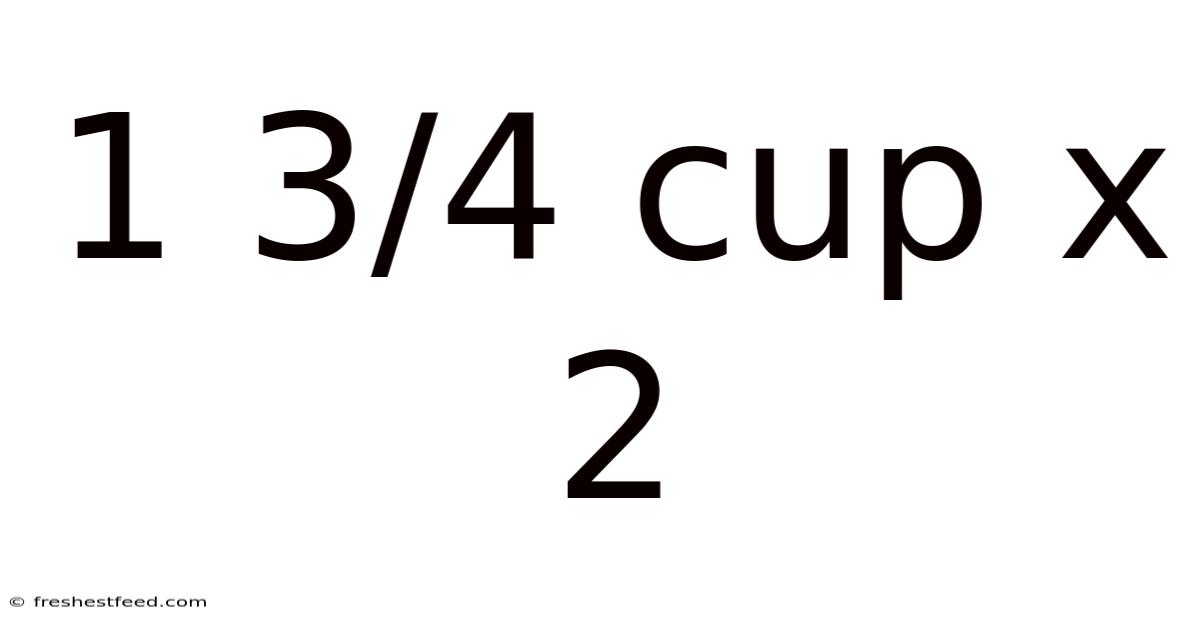
Decoding 1 3/4 Cups x 2: A Deep Dive into Fractions and Measurement Conversions
Understanding fractional measurements is crucial in various aspects of life, from baking and cooking to construction and crafting. Still, this article will comprehensively explore the calculation of 1 3/4 cups multiplied by 2, delving into the mathematical principles involved, practical applications, and addressing common misconceptions. We'll also explore related concepts to enhance your understanding of fractions and their practical uses. This guide is perfect for anyone looking to improve their fractional arithmetic skills and confidently tackle similar measurement problems.
Introduction: The Basics of Fraction Multiplication
Before tackling the specific problem of 1 3/4 cups x 2, let's review the fundamental principles of multiplying fractions. On top of that, multiplying fractions is relatively straightforward: you multiply the numerators (top numbers) together and the denominators (bottom numbers) together. Here's one way to look at it: 1/2 multiplied by 1/4 is (1 x 1) / (2 x 4) = 1/8.
Even so, when dealing with mixed numbers (like 1 3/4), we need to convert them into improper fractions first. In real terms, an improper fraction is a fraction where the numerator is larger than or equal to the denominator. To convert a mixed number to an improper fraction, we multiply the whole number by the denominator, add the numerator, and keep the same denominator.
Let's convert 1 3/4 to an improper fraction:
- Multiply the whole number by the denominator: 1 x 4 = 4
- Add the numerator: 4 + 3 = 7
- Keep the same denominator: 7/4
Which means, 1 3/4 is equivalent to 7/4.
Calculating 1 3/4 Cups x 2: Step-by-Step
Now that we've refreshed our understanding of fraction conversion, let's solve the problem: 1 3/4 cups x 2 Small thing, real impact..
-
Convert the mixed number to an improper fraction: As shown above, 1 3/4 converts to 7/4 That's the part that actually makes a difference..
-
Rewrite the multiplication problem: The problem becomes (7/4) x 2. Remember that the whole number 2 can be written as a fraction: 2/1 Small thing, real impact. And it works..
-
Multiply the numerators and denominators: (7 x 2) / (4 x 1) = 14/4
-
Simplify the resulting fraction: 14/4 can be simplified by dividing both the numerator and the denominator by their greatest common divisor, which is 2. 14 ÷ 2 = 7 and 4 ÷ 2 = 2. So, 14/4 simplifies to 7/2 Practical, not theoretical..
-
Convert the improper fraction back to a mixed number (optional): While 7/2 is a perfectly acceptable answer, it's often more practical to express the answer as a mixed number. To do this, divide the numerator by the denominator: 7 ÷ 2 = 3 with a remainder of 1. This means 7/2 is equal to 3 1/2 That's the part that actually makes a difference..
So, 1 3/4 cups x 2 equals 3 1/2 cups.
Practical Applications: Real-World Scenarios
Understanding this calculation has several practical applications:
-
Cooking and Baking: Recipes often require multiplying ingredient quantities. If a recipe calls for 1 3/4 cups of flour and you want to double the recipe, you'll need 3 1/2 cups of flour.
-
Construction and DIY: Many construction projects involve precise measurements. If you need to cut multiple pieces of wood, each requiring 1 3/4 feet of length, calculating the total length needed becomes essential But it adds up..
-
Sewing and Crafting: Similar to construction, crafting often requires accurate measurements of fabric, yarn, or other materials. Multiplying fractional measurements ensures you have the right amount of materials.
Understanding Measurement Precision and Rounding
In practical applications, especially in cooking and baking, you might need to consider rounding. So while mathematically 3 1/2 cups is the precise answer, you might find it easier to measure 3 1/2 cups using a 1-cup measuring cup and a 1/2-cup measuring cup. That said, in other contexts like construction, precise measurements are critical and rounding might lead to errors. Always consider the context and the required level of accuracy when working with measurements It's one of those things that adds up..
Beyond the Basics: Exploring Related Concepts
This problem provides a foundation for exploring more complex fractional calculations. Let's get into some related concepts:
-
Multiplying Fractions by Whole Numbers: The core principle remains the same: convert any mixed numbers to improper fractions and then multiply.
-
Multiplying Fractions by Fractions: This involves the same principle of multiplying numerators and denominators Simple, but easy to overlook..
-
Dividing Fractions: Dividing by a fraction is the same as multiplying by its reciprocal (flipping the numerator and denominator).
-
Adding and Subtracting Fractions: This requires finding a common denominator before adding or subtracting the numerators.
Mastering these concepts builds a strong foundation for handling more complex mathematical problems in various fields Easy to understand, harder to ignore. That alone is useful..
Frequently Asked Questions (FAQ)
Q: Can I multiply 1 3/4 cups by 2 without converting to an improper fraction?
A: While technically possible using a different method (distributing the multiplication), converting to an improper fraction is generally the most efficient and less error-prone method, especially as the fractions get more complex Most people skip this — try not to..
Q: What if the problem was 1 3/4 cups x 3?
A: Follow the same steps:
- Convert 1 3/4 to 7/4.
- Multiply (7/4) x (3/1) = 21/4.
- Simplify (if possible): 21/4 cannot be simplified.
- Convert to a mixed number: 21 ÷ 4 = 5 with a remainder of 1. Because of this, the answer is 5 1/4 cups.
Q: Why is it important to simplify fractions?
A: Simplifying fractions makes them easier to understand and work with. It also provides a more concise and accurate representation of the quantity Worth keeping that in mind..
Q: What are some common mistakes to avoid when multiplying fractions?
A: Common mistakes include forgetting to convert mixed numbers to improper fractions, incorrectly multiplying the numerators and denominators, and not simplifying the resulting fraction.
Conclusion: Mastering Fractional Measurements
Understanding how to calculate 1 3/4 cups x 2 – and more generally, how to work with fractions – is a fundamental skill with wide-ranging applications. By mastering the principles of fraction conversion and multiplication, you can confidently tackle similar problems in cooking, crafting, construction, and many other areas. Remember to always double-check your work, consider the context of your measurements, and strive for accuracy. Worth adding: with practice, you'll become proficient in working with fractions and confidently handle the world of precise measurements. This ability will not only enhance your problem-solving skills but will also enable you to execute tasks with greater accuracy and efficiency It's one of those things that adds up..
