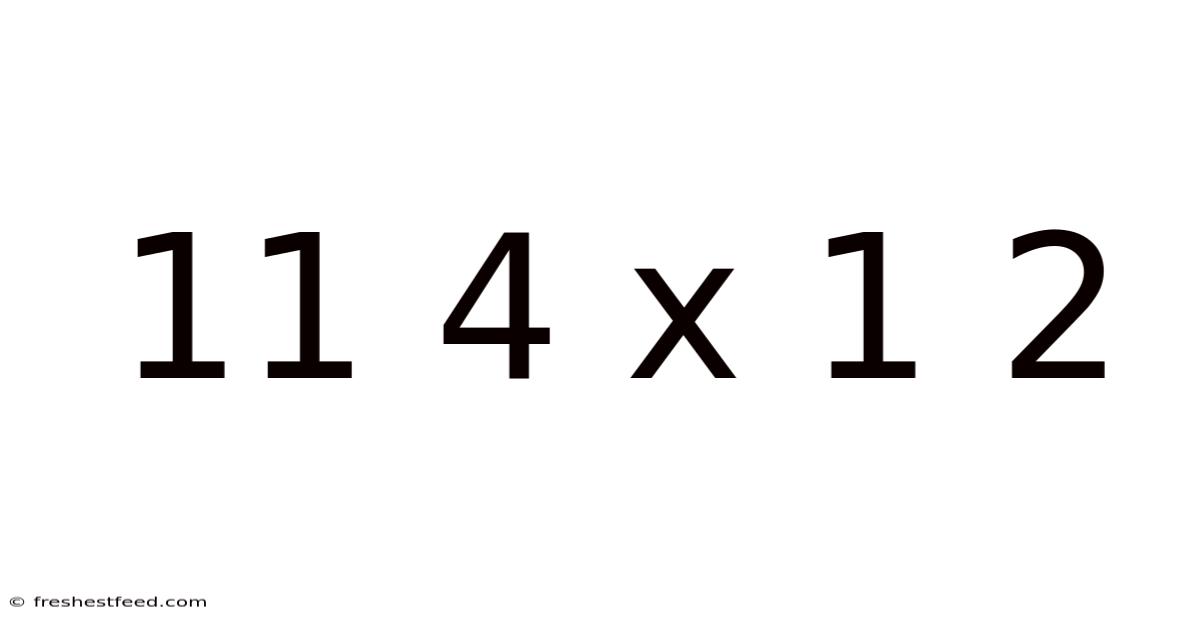
Decoding 114 x 12: A Deep Dive into Multiplication and its Applications
This article explores the seemingly simple multiplication problem, 114 x 12, as a gateway to understanding fundamental mathematical concepts and their real-world applications. We'll move beyond simply finding the answer, delving into different methods of solving the problem, exploring the underlying principles, and showcasing the relevance of multiplication in various fields. This thorough look is designed for learners of all levels, from those just grasping multiplication to those seeking a deeper understanding of its mathematical intricacies Worth keeping that in mind..
Understanding the Fundamentals: What is Multiplication?
Multiplication is a fundamental arithmetic operation representing repeated addition. And when we say 114 x 12, we're essentially asking: "What is the sum of twelve 114s? " This basic understanding lays the groundwork for more complex calculations. That's why it's the cornerstone of numerous mathematical concepts and crucial for solving problems in various fields like engineering, finance, and computer science. The numbers involved, 114 and 12, are called factors or multiplicands, while the result is called the product.
Method 1: Traditional Long Multiplication
The most common method taught in schools is long multiplication. This method involves breaking down the problem into smaller, more manageable steps:
-
Multiply 114 by 2 (the units digit of 12):
- 2 x 4 = 8
- 2 x 1 = 2
- 2 x 1 = 2
- This results in 228.
-
Multiply 114 by 10 (the tens digit of 12):
- 10 x 4 = 40
- 10 x 1 = 10
- 10 x 1 = 10
- This results in 1140. Notice we add a zero as a placeholder because we're multiplying by ten.
-
Add the partial products:
- 228 + 1140 = 1368
Which means, 114 x 12 = 1368. This method systematically breaks down the multiplication, making it easier to understand and execute, especially for larger numbers.
Method 2: Distributive Property
The distributive property of multiplication states that a(b + c) = ab + ac. We can apply this to our problem:
-
Rewrite 12 as the sum of 10 and 2: 114 x (10 + 2)
-
Apply the distributive property: (114 x 10) + (114 x 2)
-
Calculate: 1140 + 228 = 1368
This method highlights the underlying mathematical principle and showcases the flexibility of algebraic manipulation. Understanding the distributive property is essential for more advanced mathematical concepts.
Method 3: Lattice Multiplication
Lattice multiplication is a visual method that can be particularly helpful for visualizing the process and managing larger numbers. It involves creating a grid and performing smaller multiplications within each cell. While less commonly used today, it offers a unique perspective on the process.
Method 4: Using a Calculator
In today's digital age, calculators provide a quick and efficient way to solve multiplication problems. Plus, while convenient, it's crucial to understand the underlying principles to avoid relying solely on technology and to develop strong numerical reasoning skills. Calculators are tools, not replacements for understanding Simple, but easy to overlook..
Real-World Applications of Multiplication: Beyond the Classroom
Multiplication's applications extend far beyond simple arithmetic exercises. Consider these examples:
-
Finance: Calculating interest, determining total costs, managing budgets, and analyzing investments all rely heavily on multiplication. Understanding compound interest, for instance, requires a firm grasp of multiplicative growth Not complicated — just consistent. Practical, not theoretical..
-
Engineering: Designing structures, calculating material quantities, determining distances and forces, and simulating systems all involve extensive use of multiplication. From bridge construction to aerospace engineering, accurate calculations are critical.
-
Computer Science: Multiplication underpins many computer algorithms and data structures. Graphics processing, encryption techniques, and data compression all rely on efficient multiplication operations.
-
Everyday Life: Shopping (calculating the total cost of multiple items), cooking (adjusting recipes), traveling (calculating distances and travel times), and managing time effectively all involve aspects of multiplication.
Expanding the Understanding: Exploring Related Concepts
The seemingly straightforward problem, 114 x 12, opens doors to a wider understanding of mathematical concepts:
-
Factors and Multiples: Understanding factors (numbers that divide evenly into another number) and multiples (numbers that result from multiplying a number by an integer) is crucial for more advanced number theory concepts Worth keeping that in mind. Which is the point..
-
Prime Numbers and Factorization: Breaking down numbers into their prime factors (numbers divisible only by 1 and themselves) is fundamental in cryptography and other areas of mathematics.
-
Exponents and Powers: Multiplication can be extended to exponents, where a number is multiplied by itself a certain number of times (e.g., 10² = 10 x 10 = 100). This concept is essential in various scientific and engineering applications Which is the point..
-
Algebra and Equations: Multiplication is a core operation in algebraic equations and solving for unknown variables. Understanding the order of operations (PEMDAS/BODMAS) is crucial for manipulating equations correctly.
Frequently Asked Questions (FAQ)
-
Q: What are different ways to check the answer to 114 x 12?
- A: You can use different multiplication methods (as explained above), a calculator, or even reverse the operation (division: 1368 / 12 = 114).
-
Q: Is there a shortcut to multiplying by 12?
- A: While no single shortcut always applies, understanding the distributive property (12 = 10 + 2) often simplifies the process.
-
Q: How does multiplication relate to division?
- A: Multiplication and division are inverse operations. They are essentially two sides of the same coin. If you multiply two numbers, you can find one of the original numbers by dividing the product by the other number.
Conclusion: The Power of Understanding
The seemingly simple equation, 114 x 12, serves as a microcosm of the broader world of mathematics. By mastering fundamental operations like multiplication, we open up the ability to solve more complex problems and engage with the quantitative world in a meaningful way. Now, beyond just getting the answer (1368), understanding the different methods, the underlying principles, and the real-world applications significantly enriches mathematical literacy. This journey of understanding goes beyond rote memorization; it's about developing critical thinking skills and appreciating the power and elegance of mathematics in our everyday lives. Continue exploring, questioning, and practicing to get to the full potential of your mathematical abilities.
