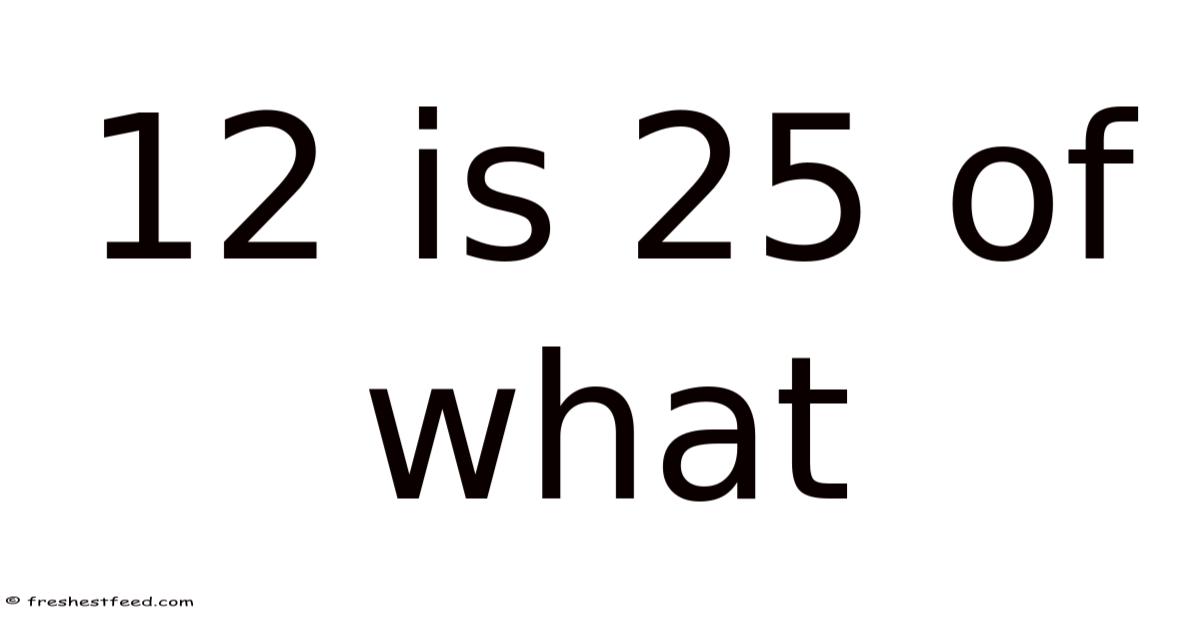
12 is 25% of What? Understanding Percentages and Solving for the Whole
Finding out what number 12 represents 25% of involves understanding the fundamental concept of percentages and applying a simple algebraic equation. Here's the thing — this seemingly simple question touches upon crucial mathematical concepts used daily in various contexts, from calculating discounts and taxes to understanding statistical data and financial reports. This article will not only provide the solution but also delve deeper into the underlying principles, offering practical examples and addressing common misconceptions to build a solid understanding of percentage calculations.
Easier said than done, but still worth knowing.
Understanding Percentages
A percentage is a way of expressing a number as a fraction of 100. And the word "percent" literally means "out of one hundred. " So, 25% means 25 out of 100, or 25/100, which simplifies to 1/4. This fractional representation is key to solving percentage problems Less friction, more output..
Think of a percentage as a part of a whole. The whole is often represented by the number 100%, while smaller portions are represented by percentages less than 100%. Take this: 50% represents half of the whole (50/100 = 1/2), and 75% represents three-quarters of the whole (75/100 = 3/4).
Solving for the Whole: The Algebraic Approach
The problem "12 is 25% of what?That said, " can be translated into an algebraic equation. Let's represent the unknown whole number as 'x'.
0.25 * x = 12
This equation states that 25% (or 0.Plus, to solve for 'x', we need to isolate it on one side of the equation. 25 as a decimal) of 'x' is equal to 12. We can do this by dividing both sides of the equation by 0 Not complicated — just consistent..
x = 12 / 0.25
Performing the division:
x = 48
Because of this, 12 is 25% of 48 Still holds up..
Alternative Methods: Using Fractions
Instead of using decimals, we can solve this problem using fractions. Remember, 25% is equivalent to 1/4. So, the equation becomes:
(1/4) * x = 12
To solve for 'x', we multiply both sides of the equation by 4:
x = 12 * 4
x = 48
This method demonstrates that the same result can be achieved using fractions, reinforcing the understanding of the underlying mathematical principles Not complicated — just consistent..
Practical Applications: Real-World Examples
Understanding how to calculate percentages and solve for the whole has numerous real-world applications. Here are a few examples:
-
Discounts: If a store offers a 25% discount on an item, and the discount amount is $12, you can use this method to find the original price of the item. In this case, $12 represents 25% of the original price, so the original price is $48 Most people skip this — try not to. Took long enough..
-
Taxes: If a sales tax of 6% on an item amounts to $3, you can find the pre-tax price of the item by using a similar approach. In this scenario, you'd solve the equation 0.06x = 3 to find the value of x (the pre-tax price).
-
Commission: Salespeople often earn a commission based on a percentage of their sales. If a salesperson earns a 10% commission, and their commission for a particular sale is $50, you can find the total sales amount by solving the equation 0.10x = 50.
-
Statistical Data: Percentages are frequently used in statistical analysis to represent proportions within a dataset. Here's one way to look at it: if 25% of survey respondents chose a specific answer, and that number is 12, you can determine the total number of respondents.
-
Financial Calculations: From calculating interest earned on savings accounts to understanding loan repayments, percentage calculations are essential in various financial contexts The details matter here. That's the whole idea..
Common Mistakes and Misconceptions
While the calculation itself is relatively straightforward, several common mistakes can arise when working with percentages:
-
Confusing percentage increase/decrease with absolute values: A 25% increase on 100 is different from a 25% decrease on 100. Students often fail to properly apply the percentage change to the original value.
-
Incorrect conversion between fractions, decimals, and percentages: Failing to correctly convert between these three forms can lead to erroneous calculations. Remember that to convert a percentage to a decimal, divide by 100. To convert a decimal to a percentage, multiply by 100. To convert a fraction to a percentage, you can convert the fraction to a decimal first, and then to a percentage.
-
Ignoring the order of operations: Remember to follow the order of operations (PEMDAS/BODMAS) when solving complex equations involving percentages. Parentheses, exponents, multiplication and division (from left to right), and addition and subtraction (from left to right).
-
Rounding errors: Pay attention to the level of precision required. Rounding off numbers prematurely during calculations can lead to inaccuracies in the final answer Simple, but easy to overlook..
Expanding Your Understanding: Further Exploration
To solidify your grasp of percentage calculations, you can explore these related concepts:
-
Percentage change: This involves calculating the percentage increase or decrease between two values. The formula is: [(New Value - Old Value) / Old Value] * 100% That's the part that actually makes a difference..
-
Compound interest: This is interest calculated on the initial principal, as well as on the accumulated interest from previous periods. It demonstrates the power of exponential growth.
-
Proportions and ratios: These are closely related concepts that involve comparing different quantities. Understanding proportions helps in solving many percentage problems And it works..
Frequently Asked Questions (FAQ)
-
Q: Can I use a calculator to solve this type of problem?
- A: Yes, absolutely! Calculators make these calculations quick and efficient. Even so, understanding the underlying methodology is still crucial for problem-solving and to avoid relying solely on the calculator without grasping the concepts.
-
Q: What if the percentage is more than 100%?
- A: A percentage greater than 100% simply means that the part is larger than the whole. The same algebraic method applies; you would just end up with a value of 'x' larger than the given part. As an example, if 150% of a number is 60, the equation would be 1.5x = 60, and solving for x would give you 40.
-
Q: How can I improve my skills in solving percentage problems?
- A: Consistent practice is key. Work through various examples, starting with simpler problems and gradually moving towards more complex ones. Try using different methods (decimals, fractions) to develop a well-rounded understanding.
Conclusion
Understanding how to determine "12 is 25% of what?It represents a fundamental skill applicable in diverse everyday situations. " extends far beyond a simple mathematical problem. Which means by mastering the techniques outlined here, you equip yourself with a crucial tool for tackling numerical challenges in academics, professional life, and personal finance. Remember to practice regularly, explore related concepts, and approach problems systematically to solidify your comprehension and build confidence in tackling percentage calculations. The more you practice, the easier and more intuitive these calculations will become.
