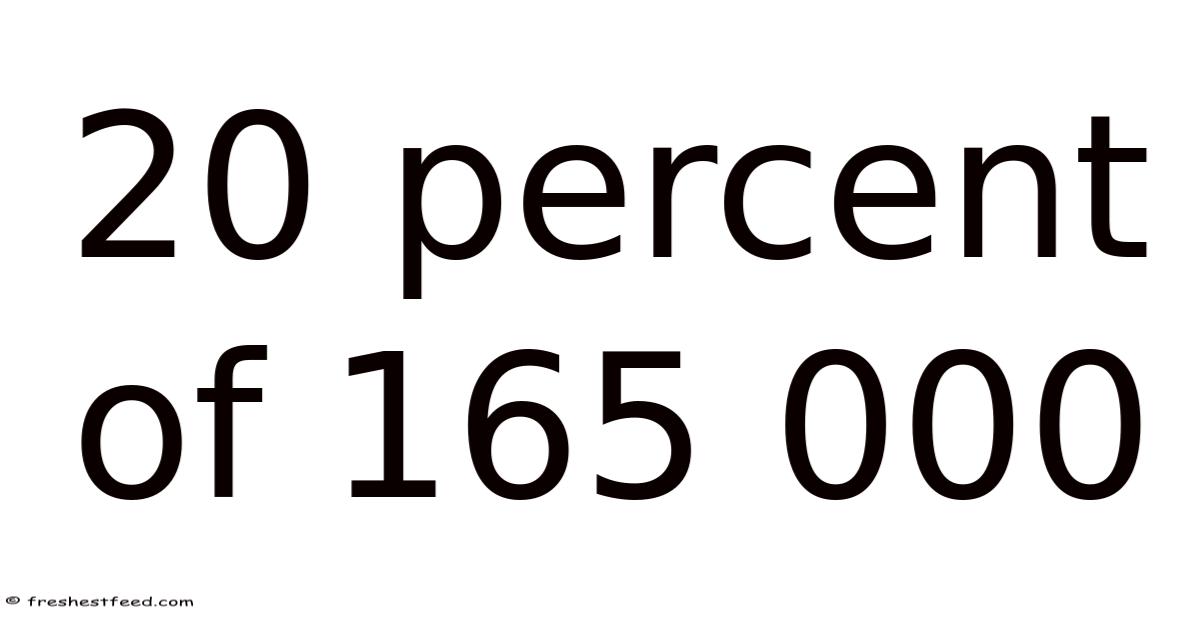
Calculating 20% of 165,000: A complete walkthrough
Finding 20% of 165,000 might seem like a simple arithmetic problem, but understanding the underlying concepts and exploring different calculation methods can be incredibly valuable, especially when dealing with percentages in various real-world scenarios, such as finance, budgeting, and sales. This full breakdown will not only show you how to calculate 20% of 165,000 but also dig into the underlying principles and provide you with multiple approaches, ensuring you fully grasp this fundamental mathematical concept.
Introduction: Understanding Percentages
Percentages are a fundamental part of mathematics and are used extensively in everyday life. Here's one way to look at it: 20% means 20 out of 100, which can be written as the fraction 20/100 or the decimal 0.This article will focus on calculating 20% of 165,000, illustrating several methods and highlighting their applications. Practically speaking, 20. Understanding this basic principle is crucial for accurately calculating percentages. In real terms, a percentage is a fraction or ratio expressed as a number out of 100. We'll cover the direct calculation method, using decimals, fractions, and even exploring proportional reasoning – useful tools for various percentage problems.
Method 1: Direct Calculation Using Decimals
This is arguably the most straightforward method. Remember that 20% is equivalent to 0.But 20 (20 divided by 100). That's why, to find 20% of 165,000, we simply multiply 165,000 by 0 That's the part that actually makes a difference..
165,000 x 0.20 = 33,000
So, 20% of 165,000 is 33,000. This method is efficient and easily adaptable to calculating other percentages. Simply replace 0.20 with the decimal equivalent of the desired percentage.
Method 2: Using Fractions
Percentages can also be expressed as fractions. 20% can be written as 20/100, which simplifies to 1/5. To find 20% of 165,000 using this method, we multiply 165,000 by 1/5:
165,000 x (1/5) = 165,000 ÷ 5 = 33,000
This method demonstrates the relationship between percentages, fractions, and division. It's particularly useful when the percentage can be simplified to a simple fraction, making the calculation easier That's the part that actually makes a difference. Still holds up..
Method 3: Proportional Reasoning
Proportional reasoning is a powerful technique for solving percentage problems. It's based on the principle of equivalent ratios. We can set up a proportion:
Let x be 20% of 165,000
20/100 = x/165,000
To solve for x, we cross-multiply:
20 * 165,000 = 100 * x
3,300,000 = 100x
x = 3,300,000 / 100
x = 33,000
This method reinforces the concept of ratios and provides a structured approach to solving percentage problems. It is particularly useful when dealing with more complex percentage calculations.
Method 4: Breaking it Down – Using 10% as a Building Block
This method is excellent for mental calculation or when you don't have a calculator readily available. First, find 10% of 165,000:
165,000 x 0.10 = 16,500
Since 20% is double 10%, we simply multiply the result by 2:
16,500 x 2 = 33,000
This approach is intuitive and helps build number sense. It's especially helpful for estimating percentages quickly Turns out it matters..
Real-World Applications: Why is this important?
Understanding how to calculate percentages, particularly 20%, has wide-ranging applications in various real-world scenarios. Consider these examples:
-
Finance: Calculating interest rates, discounts, tax amounts, and profit margins all involve percentages. Understanding these calculations is crucial for managing personal finances and making informed financial decisions. Take this case: if a property is valued at 165,000 and you are looking for a 20% down payment, this calculation directly helps you determine the required amount Which is the point..
-
Sales and Marketing: Discounts, sales commissions, and market share analysis often rely on percentage calculations. Businesses use these calculations to set prices, incentivize sales, and track performance. Knowing how to quickly calculate 20% off a sale price is a valuable skill for both consumers and businesses Nothing fancy..
-
Data Analysis: Percentages are essential for interpreting and presenting data. Take this case: if 20% of a survey population responded positively to a particular question, understanding percentage calculation is key to interpreting and reporting the data accurately.
-
Everyday Budgeting: Budgeting often involves allocating a certain percentage of your income to different categories (e.g., rent, food, transportation). Calculating 20% of your income to allocate for savings is a practical application of this skill.
-
Science and Engineering: Percentages are commonly used to express concentrations, errors, and efficiency rates in scientific and engineering contexts.
Frequently Asked Questions (FAQ)
-
What if I need to calculate a different percentage of 165,000? Simply replace 0.20 (or 20/100) in the calculations above with the decimal or fraction equivalent of the desired percentage It's one of those things that adds up. Which is the point..
-
Can I use a calculator for this? Absolutely! Calculators are efficient tools for calculating percentages, especially for larger numbers. Even so, understanding the underlying principles is crucial, even if using a calculator The details matter here..
-
Why are multiple methods presented? Different methods cater to different learning styles and problem-solving preferences. Understanding multiple approaches can enhance your overall mathematical understanding and adaptability Small thing, real impact..
-
What if the number isn't a whole number? The same methods apply, even if the number is a decimal. The calculations are performed in exactly the same manner Took long enough..
-
Is there a formula for calculating percentages? The basic formula is: (Percentage/100) * Total Value.
Conclusion: Mastering Percentage Calculations
Calculating 20% of 165,000, resulting in 33,000, is a straightforward calculation, but understanding the different methods and their applications extends far beyond this specific problem. Mastering percentage calculations is a crucial skill applicable in numerous fields and everyday life situations. By understanding the various approaches—using decimals, fractions, proportional reasoning, or even the 10% building block method—you can confidently tackle percentage calculations of any size and complexity. Practically speaking, remember, practice makes perfect! That said, the more you work with percentages, the more comfortable and efficient you'll become. This skill will serve you well in your personal life, your professional endeavors, and your further mathematical studies.
