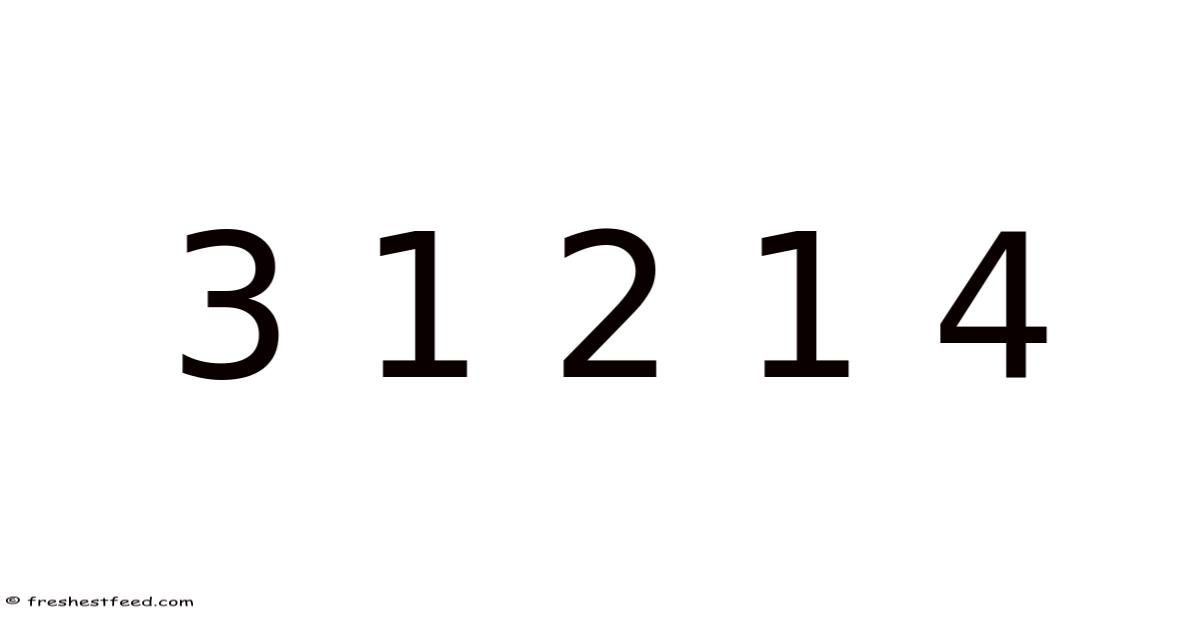
Decoding the Mysterious 3 1 2 1 4 Sequence: A Deep Dive into its Potential Meanings and Applications
The seemingly simple sequence "3 1 2 1 4" might appear innocuous at first glance. Consider this: this article will explore the various interpretations and potential applications of this numerical sequence, examining its possible origins and offering different perspectives on its significance. Still, depending on the context, this sequence can hold significant meaning, ranging from a simple code to a complex mathematical or musical pattern. We'll dig into the potential for hidden meanings, explore its mathematical properties, and consider its potential usage in different fields.
Understanding the Context: The Importance of Interpretation
Before we begin analyzing "3 1 2 1 4," it's crucial to understand that the interpretation hinges entirely on the context in which it appears. Without knowing the source or intended meaning, any analysis remains purely speculative. Is it a code, a musical notation, a part of a larger mathematical equation, or something else entirely? This ambiguity opens up a wide range of possibilities Still holds up..
Take this: if found within a fictional story, the sequence could represent a crucial clue or a secret code. In real terms, in a scientific context, it could represent a series of measurements, experimental results, or even a pattern in a natural phenomenon. Day to day, in music, it could indicate rhythmic values or note durations. Which means, a definitive answer requires additional information.
Potential Interpretations and Analyses
Given the lack of a definitive source, we can explore several potential interpretations, keeping in mind their speculative nature It's one of those things that adds up..
1. A Simple Numerical Sequence: Purely Descriptive Analysis
At its most basic level, "3 1 2 1 4" is just a sequence of five integers. We can analyze it purely numerically, looking at:
- Sum: The sum of the numbers is 11 (3 + 1 + 2 + 1 + 4 = 11).
- Average: The average is 2.2 (11 / 5 = 2.2).
- Frequency: The number "1" appears twice, while "3," "2," and "4" appear once each.
- Patterns: No immediately obvious mathematical pattern (like arithmetic or geometric progression) is apparent. On the flip side, more sophisticated mathematical analysis could reveal hidden patterns or correlations. To give you an idea, could this sequence be part of a larger, more complex fractal pattern? This requires extensive mathematical modeling.
2. A Code or Cipher: Cryptographic Perspectives
The sequence could represent a simple code or cipher. Deciphering it requires a key or additional context. Possible approaches include:
- Substitution Cipher: Each number could represent a letter of the alphabet (e.g., A=1, B=2, etc.), resulting in a short coded message. That said, without a key or further information, this approach is highly speculative.
- Polyalphabetic Cipher: More complex ciphers, like the Vigenère cipher, could be involved, requiring a keyword to decipher the message. Again, context is crucial.
- Numerical Code: The sequence could represent coordinates, dates, or other numerical data relevant to a specific system.
Without further clues, determining if this is a code is impossible.
3. Musical Interpretation: Rhythmic and Melodic Possibilities
In music, the sequence could represent rhythmic values or note durations. Take this case: in a time signature like 4/4, each number could represent the number of beats:
- 3: A triplet (three eighth notes in the space of two quarter notes).
- 1: A quarter note.
- 2: Two eighth notes.
- 1: A quarter note.
- 4: A whole note.
That said, this interpretation is highly dependent on the musical context (tempo, key, instrument, etc.). The sequence could also represent other musical parameters, such as melodic intervals or dynamic levels.
4. Part of a Larger Sequence or Pattern: Fractals and Recursion
The sequence could be a small segment of a much larger, more detailed sequence. Even so, this larger sequence might exhibit fractal properties, meaning it contains self-similar patterns at different scales. This is a fascinating area of mathematical study and requires advanced mathematical analysis to determine if such a pattern exists That's the whole idea..
Consider the possibility of the sequence repeating, or being part of a Fibonacci-like sequence with modified rules. These are complex areas that would demand specialized mathematical modeling and software.
5. Experimental Data or Measurements: Scientific Context
In a scientific context, "3 1 2 1 4" could represent experimental data or measurements obtained during an experiment or observation. The meaning would depend entirely on the nature of the experiment and the units of measurement used. Without knowing the context of the experiment, it's impossible to decipher the meaning. This could represent anything from particle counts in physics to chemical concentrations in chemistry Worth keeping that in mind..
6. A Random Sequence: Statistical Probability
Finally, you'll want to acknowledge the possibility that the sequence is simply random. While patterns are often sought, statistically speaking, any finite sequence of numbers could occur by chance. Determining the probability of this particular sequence appearing randomly would require statistical analysis and consideration of the probability distribution from which the numbers were drawn That's the part that actually makes a difference..
Quick note before moving on.
Further Investigation and Conclusion
The true meaning of the sequence "3 1 2 1 4" remains elusive without additional context. The analysis presented here explores various potential interpretations, highlighting the importance of context in decoding any numerical sequence. To reach a definitive conclusion, we need more information about its origin and the circumstances in which it appeared Surprisingly effective..
The exploration, however, has illuminated several important points:
- Ambiguity of Numerical Sequences: Simple numerical sequences can hold a multitude of meanings depending on context.
- Importance of Context: Context is crucial for interpreting any code or sequence of numbers.
- Interdisciplinary Approach: Deciphering such sequences often requires expertise from diverse fields like mathematics, cryptography, music theory, and statistics.
- Need for Further Information: More information is needed to uncover the true meaning of "3 1 2 1 4".
Future research could involve:
- Database Searches: Searching large databases of codes, ciphers, mathematical sequences, and musical scores for instances of this sequence.
- Statistical Analysis: Performing extensive statistical analysis to determine the likelihood of the sequence occurring randomly.
- Mathematical Modeling: Developing mathematical models to explore the possibility of the sequence being part of a larger, more complex pattern.
This investigation into "3 1 2 1 4" serves as a reminder of the power and ambiguity inherent in numerical sequences and the crucial role context plays in their interpretation. While we haven't definitively unlocked its secret, the journey of exploration highlights the richness of interdisciplinary thinking and the fascinating interplay of numbers, codes, and context.
