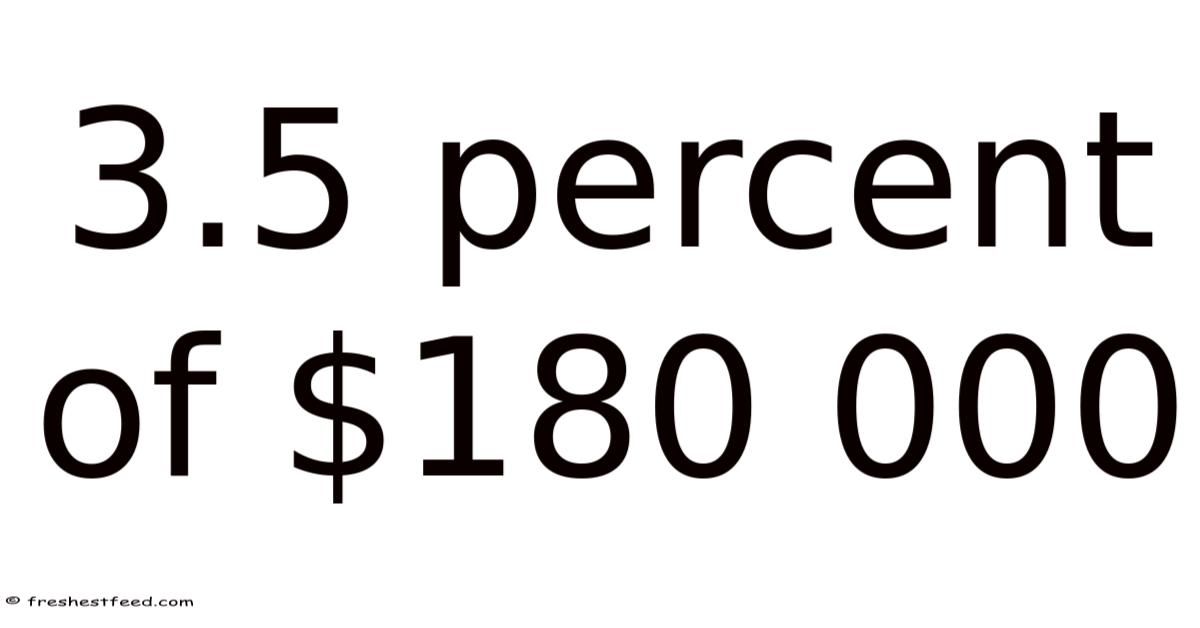
Decoding 3.5% of $180,000: A practical guide to Percentage Calculations
Calculating percentages is a fundamental skill applicable across numerous fields, from personal finance and budgeting to business analysis and scientific research. Now, understanding how to determine a percentage of a given amount is crucial for making informed decisions and interpreting data effectively. This article provides a complete walkthrough to calculating 3.In practice, 5% of $180,000, explaining the methodology step-by-step, exploring various approaches, and delving into the practical applications of such calculations. We'll also address common questions and misconceptions surrounding percentage calculations.
Understanding Percentages: The Basics
Before diving into the calculation of 3.5% of $180,000, let's revisit the fundamental concept of percentages. The symbol "%" represents "per cent," meaning "out of one hundred.A percentage is a fraction or ratio expressed as a number out of 100. That's why 5% can be written as the fraction 3. " Because of this, 3.5/100 or the decimal 0.035.
Method 1: Direct Calculation using Decimal Conversion
Basically the most straightforward method. We convert the percentage to its decimal equivalent and then multiply it by the given amount.
Steps:
- Convert the percentage to a decimal: 3.5% = 3.5/100 = 0.035
- Multiply the decimal by the given amount: 0.035 * $180,000 = $6,300
Because of this, 3.5% of $180,000 is $\boxed{$6,300}$ Small thing, real impact..
Method 2: Fraction Calculation
This method involves expressing the percentage as a fraction and then performing the multiplication Easy to understand, harder to ignore..
Steps:
- Express the percentage as a fraction: 3.5% = 3.5/100 = 7/200 (Simplifying the fraction)
- Multiply the fraction by the given amount: (7/200) * $180,000 = 7 * ($180,000/200) = 7 * $900 = $6,300
Again, we arrive at the same result: 3.5% of $180,000 is $\boxed{$6,300}$.
Method 3: Using Proportions
This method utilizes the concept of ratios and proportions to solve the problem That's the part that actually makes a difference..
Steps:
- Set up a proportion: We can set up a proportion as follows: x / $180,000 = 3.5 / 100
- Solve for x: To solve for x (which represents 3.5% of $180,000), we cross-multiply: 100x = 3.5 * $180,000
- Isolate x: x = (3.5 * $180,000) / 100 = $630,000 / 100 = $6,300
Once more, the calculation confirms that 3.5% of $180,000 is $\boxed{$6,300}$.
Practical Applications: Real-World Scenarios
Understanding how to calculate percentages like 3.5% of $180,000 has numerous real-world applications. Here are a few examples:
- Real Estate: Calculating the down payment on a house. If a down payment of 3.5% is required for a $180,000 property, the buyer needs to pay $6,300 upfront.
- Sales Tax: Determining the sales tax on a purchase. If the sales tax rate is 3.5%, the tax on a $180,000 item would be $6,300.
- Investment Returns: Calculating investment gains or losses. If an investment of $180,000 yields a 3.5% return, the profit would be $6,300.
- Commission Calculations: Determining a salesperson's commission. A salesperson earning a 3.5% commission on $180,000 in sales would receive $6,300.
- Financial Analysis: Assessing the profitability or efficiency of a business. Calculating percentage changes in revenue, expenses, or profit margins is a common practice in financial analysis. Here's a good example: a 3.5% increase in revenue on a base of $180,000 would represent a $6,300 increase.
Beyond the Basics: Dealing with More Complex Percentages
The methods described above can be easily adapted to handle more complex percentage calculations. Take this: if you need to calculate 12.75% of $180,000, you would simply convert 12.Because of that, 75% to its decimal equivalent (0. Think about it: 1275) and multiply it by $180,000. The same principles apply to any percentage.
This is the bit that actually matters in practice.
Worth adding, these methods can be used to solve for the original amount or the percentage itself if other values are known. Here's one way to look at it: if you know that a certain percentage of $180,000 is $9,000, you can set up a proportion to solve for the unknown percentage.
Frequently Asked Questions (FAQs)
Q1: Why are there multiple methods to calculate percentages?
A1: Different methods cater to different learning styles and problem-solving approaches. Some individuals find the decimal method more intuitive, while others prefer the fraction or proportion method. Using multiple methods can also serve as a check for accuracy.
Q2: What if the percentage is a fraction, such as 1/4%?
A2: Convert the fraction to a decimal first. 25%, which is 0.On top of that, 1/4% is equivalent to 0. 0025 as a decimal. Then, multiply this decimal by the given amount Still holds up..
Q3: Can I use a calculator for percentage calculations?
A3: Absolutely! That said, most calculators have a percentage function (%) that simplifies the process. You can simply enter the percentage, press the "%" button, and then multiply by the given amount Most people skip this — try not to. That's the whole idea..
Q4: How can I improve my understanding of percentages?
A4: Practice is key! Try working through various percentage problems using different methods. Think about it: you can find practice problems online or in textbooks. Understanding the underlying concepts of fractions, decimals, and proportions will also strengthen your ability to calculate percentages accurately.
Conclusion: Mastering Percentage Calculations
Calculating percentages is a fundamental skill with broad applicability in various aspects of life. Practically speaking, understanding the different methods for calculating percentages, such as converting to decimals, using fractions, or employing proportions, provides flexibility and enhances problem-solving capabilities. Day to day, the ability to accurately and efficiently compute percentages empowers individuals to make informed financial decisions, interpret data effectively, and succeed in numerous academic and professional settings. Also, regular practice and a solid understanding of the underlying mathematical principles are crucial for mastering this essential skill. Here's the thing — remember, consistent practice will transform the seemingly complex world of percentage calculations into a confident and intuitive process. By applying the methods discussed in this article, you can confidently tackle any percentage calculation, no matter the complexity. From determining a down payment on a house to understanding investment returns, a strong grasp of percentage calculations is a valuable asset.
Some disagree here. Fair enough.
