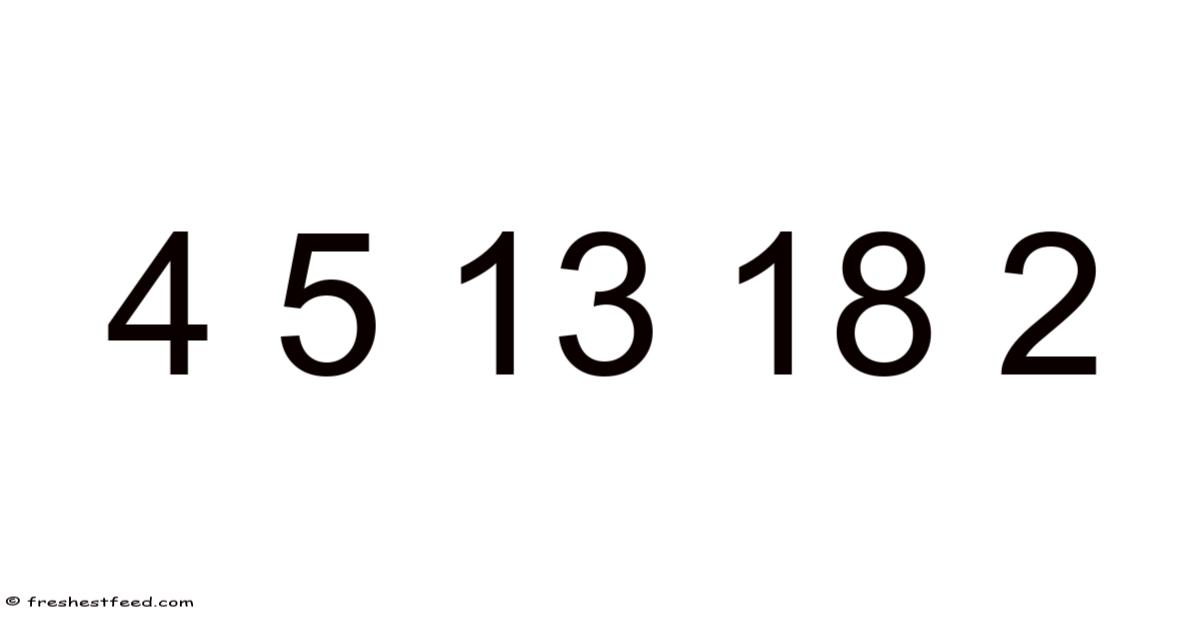
Unraveling the Mystery: Exploring the Sequence 4, 5, 13, 18, 2
This seemingly random sequence of numbers – 4, 5, 13, 18, 2 – presents a fascinating challenge. At first glance, it appears to lack any obvious pattern. On the flip side, by applying different mathematical and logical approaches, we can uncover multiple potential underlying rules, demonstrating the beauty of mathematical exploration and the multiple ways to interpret seemingly simple data. So this article will get into various methods of analyzing this sequence, revealing not just one solution, but several possible explanations, highlighting the importance of critical thinking and diverse perspectives in problem-solving. Understanding these different approaches will enhance your ability to decipher patterns and solve similar mathematical puzzles Simple, but easy to overlook..
I. Introduction: The Allure of Numerical Sequences
Numerical sequences have captivated mathematicians and puzzle enthusiasts for centuries. The challenge lies in identifying the rule or pattern that governs the progression of numbers. These patterns can be deceptively simple, yet their discovery can access deeper mathematical insights. Our exploration of the sequence 4, 5, 13, 18, 2 will demonstrate how a seemingly straightforward problem can lead to a rich understanding of various mathematical concepts, from simple arithmetic to more complex pattern recognition.
II. Method 1: Analyzing Differences and Second Differences
One common method for analyzing numerical sequences is to examine the differences between consecutive terms. Let's apply this to our sequence:
- First Differences: 5 - 4 = 1; 13 - 5 = 8; 18 - 13 = 5; 2 - 18 = -16
The first differences (1, 8, 5, -16) don't immediately reveal a clear pattern. Let's try calculating the second differences:
- Second Differences: 8 - 1 = 7; 5 - 8 = -3; -16 - 5 = -21
Again, no obvious pattern emerges. And this suggests that a simple linear or quadratic relationship might not be at play. This doesn't mean there's no pattern; it simply means we need to explore other approaches.
III. Method 2: Exploring Prime Numbers and Factorization
Let's consider the prime factorization of each number:
- 4 = 2 x 2
- 5 = 5
- 13 = 13
- 18 = 2 x 3 x 3
- 2 = 2
While the prime factorization doesn't immediately reveal a consistent pattern, it does highlight the presence of prime numbers (5 and 13) within the sequence. This observation could be a starting point for formulating a more complex rule involving prime numbers or their properties. Think about it: perhaps the sequence incorporates a rule that alternates between composite and prime numbers or involves the number of prime factors. Further investigation is needed to validate this possibility That's the part that actually makes a difference. That alone is useful..
Not obvious, but once you see it — you'll see it everywhere.
IV. Method 3: Modular Arithmetic and Cyclical Patterns
Let's examine the sequence using modular arithmetic. Consider this: we could explore different moduli (e. In practice, g. , modulo 3, modulo 4, modulo 5) to see if any cyclical patterns emerge.
- 4 mod 3 = 1
- 5 mod 3 = 2
- 13 mod 3 = 1
- 18 mod 3 = 0
- 2 mod 3 = 2
This shows some sort of pattern related to the remainder, but it's not immediately clear enough to confidently define a rule. Further investigation with different moduli is necessary to determine if a consistent cyclical pattern exists.
V. Method 4: Recursive Relationships
Another approach involves looking for a recursive relationship, where each term is defined based on the preceding terms. This could involve addition, subtraction, multiplication, or a combination of operations. Let's try some simple recursive possibilities:
-
Option A: Could it be a combination of addition and multiplication? It's unlikely given the chaotic nature of the first differences Most people skip this — try not to..
-
Option B: Perhaps a more complex recursive formula involving multiple previous terms is needed. Finding such a formula could require extensive trial and error or the use of more advanced mathematical techniques.
-
Option C: A recursive function involving modulo operations could create an apparent random sequence that, upon closer inspection with specific parameters, could yield a predictable outcome.
The absence of a readily apparent recursive relationship highlights the potential complexity underlying this sequence. More sophisticated methods, possibly involving computer algorithms or symbolic mathematics software, may be necessary to uncover a complex recursive rule That's the whole idea..
VI. Method 5: Considering External Factors or Context
It's crucial to consider whether the sequence is part of a larger context. Was this sequence presented within a specific problem or scenario? Additional information could provide valuable clues.
- Is this a coded message? The numbers could represent letters or symbols in a cipher.
- Is this a part of a larger dataset? Additional numbers could reveal a clearer pattern.
- Is there a specific domain or field of study associated with the sequence? Knowing the source could offer valuable insights into the underlying logic.
Without further context, we can only speculate on potential external factors influencing the sequence.
VII. Method 6: Approaching the Problem from a Different Perspective
Sometimes, the solution to a mathematical puzzle lies in reframing the problem. Consider the following:
- Rearrangement: Is there a meaningful order or rearrangement of the numbers that reveals a clearer pattern?
- Operations: Could specific mathematical operations (e.g., addition, subtraction, multiplication, division, exponentiation, factorials) applied to the numbers produce a more coherent sequence?
- Geometric interpretations: Could the numbers be interpreted geometrically, representing points, lengths, or areas?
Exploring these alternative approaches could uncover hidden relationships within the sequence.
VIII. Conclusion: The Multiplicity of Solutions
Our exploration of the sequence 4, 5, 13, 18, 2 has demonstrated the richness and complexity of mathematical pattern recognition. While we haven't found a single definitive solution, we've explored various mathematical techniques, each suggesting potential underlying rules. The lack of a readily apparent solution highlights the importance of considering multiple perspectives and approaches when tackling mathematical challenges Not complicated — just consistent..
The initial simplicity of the sequence belies its potential complexity. Worth adding: without further context or information, multiple interpretations remain possible. This ambiguity highlights the multifaceted nature of mathematical problem-solving and encourages further investigation using more advanced techniques and potentially, the use of computational tools.
IX. FAQ
Q: Is there only one correct answer to this problem?
A: No, without additional context or constraints, multiple rules could generate the given sequence. The goal isn't necessarily to find the correct answer but to explore different methods and potential solutions.
Q: What if I find a different pattern?
A: That's perfectly acceptable! Practically speaking, mathematical exploration often involves discovering multiple possible interpretations. Sharing your findings and the methodology used to arrive at your conclusion would be valuable in enriching our understanding of the sequence.
Q: Are there any tools or software that could help solve this?
A: Yes, computer programs capable of pattern recognition and mathematical modeling could be used to explore more complex relationships and potentially discover more elaborate rules that generate the sequence Simple, but easy to overlook..
Q: What are the key takeaways from this analysis?
A: The key takeaways are the importance of:
- Multiple approaches: Utilizing different mathematical techniques to analyze sequences.
- Critical thinking: Examining the results critically and considering alternative interpretations.
- Contextual awareness: Recognizing that additional information or context could significantly influence the solution.
- Persistence and creativity: Not giving up easily and exploring unconventional approaches.
The analysis of this sequence showcases the creative and investigative nature of mathematics and the importance of a multi-faceted approach to problem-solving. The seemingly simple sequence serves as a reminder that even seemingly random numbers can hold hidden patterns, rewarding those who persevere in their pursuit of understanding It's one of those things that adds up. Practical, not theoretical..
