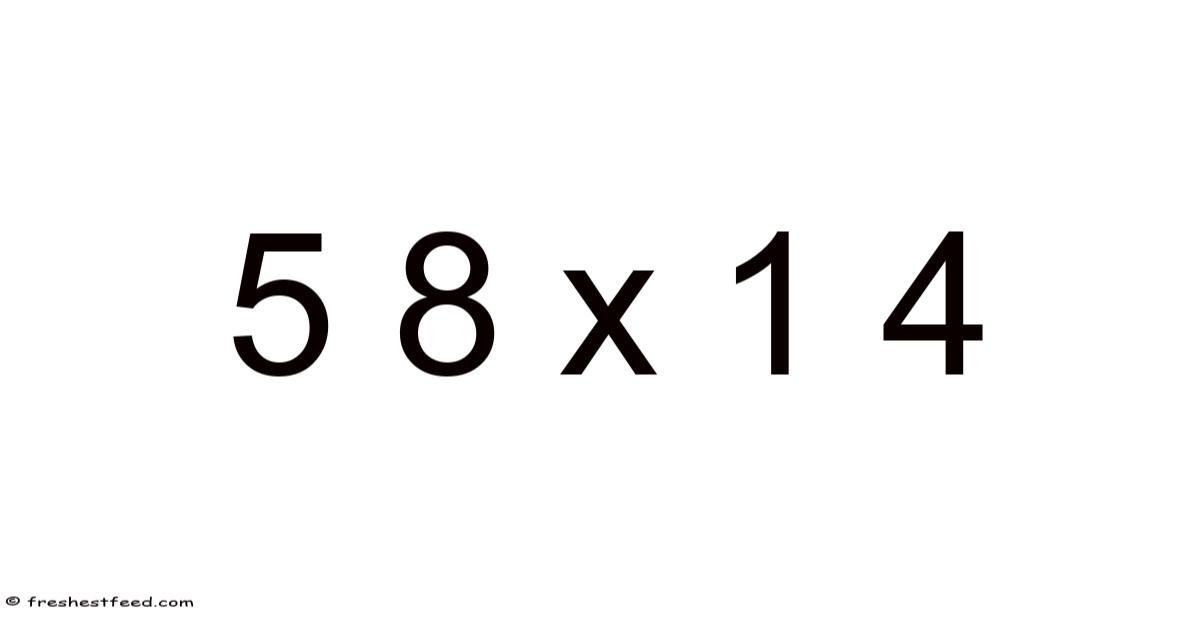
Decoding the Mystery: A Deep Dive into 5/8 x 1 1/4
The seemingly simple expression "5/8 x 1 1/4" might look innocuous at first glance. Still, this seemingly straightforward calculation touches upon fundamental concepts in mathematics, particularly fractions and mixed numbers, that are crucial for various applications in everyday life and specialized fields. Practically speaking, this article will dig into the intricacies of solving this calculation, providing a step-by-step guide, exploring the underlying mathematical principles, and addressing common misconceptions. We'll uncover why understanding this seemingly simple equation is vital, extending far beyond basic arithmetic Worth keeping that in mind..
Understanding the Components: Fractions and Mixed Numbers
Before tackling the multiplication, let's clarify the components: 5/8 and 1 1/4. In real terms, these are examples of fractions and mixed numbers, respectively. A fraction represents a part of a whole, consisting of a numerator (the top number) and a denominator (the bottom number). Day to day, the numerator indicates how many parts we have, and the denominator shows how many equal parts the whole is divided into. In 5/8, we have 5 parts out of a total of 8 equal parts.
A mixed number combines a whole number and a fraction, like 1 1/4. Practically speaking, this represents one whole unit plus 1/4 of another unit. To perform calculations effectively, it's often beneficial to convert mixed numbers into improper fractions. An improper fraction has a numerator larger than or equal to its denominator.
Converting Mixed Numbers to Improper Fractions
To convert 1 1/4 to an improper fraction, we follow these steps:
- Multiply the whole number by the denominator: 1 x 4 = 4
- Add the numerator to the result: 4 + 1 = 5
- Keep the same denominator: 4
Which means, 1 1/4 is equivalent to 5/4 Nothing fancy..
Multiplying Fractions: A Step-by-Step Guide
Now that we have both numbers expressed as fractions (5/8 and 5/4), we can proceed with the multiplication. Multiplying fractions is a straightforward process:
- Multiply the numerators: 5 x 5 = 25
- Multiply the denominators: 8 x 4 = 32
This gives us the result 25/32.
Simplifying Fractions: Finding the Greatest Common Divisor (GCD)
While 25/32 is a correct answer, it's often preferable to express fractions in their simplest form. This means reducing the fraction to its lowest terms by finding the greatest common divisor (GCD) of the numerator and the denominator. The GCD is the largest number that divides both the numerator and the denominator without leaving a remainder Easy to understand, harder to ignore..
In this case, the GCD of 25 and 32 is 1. Also, since the GCD is 1, the fraction 25/32 is already in its simplest form. This means it cannot be further reduced.
Illustrative Examples and Real-World Applications
Understanding the calculation 5/8 x 1 1/4 extends beyond a simple arithmetic problem. Let's explore some practical examples:
-
Baking: If a recipe calls for 5/8 of a cup of sugar and you want to make 1 1/4 times the recipe, you would multiply 5/8 by 1 1/4 to find the total amount of sugar needed. The answer, 25/32 of a cup, helps ensure accurate baking Most people skip this — try not to..
-
Construction and Engineering: Calculations involving fractions are common in construction and engineering. To give you an idea, determining the length of a beam or the amount of material needed often involves fractions and mixed numbers, mirroring the process we’ve undertaken Small thing, real impact..
-
Data Analysis: Data analysis frequently involves working with proportions and percentages which are directly related to fractional calculations. Understanding fractional multiplication is a fundamental skill in analyzing and interpreting data And that's really what it comes down to. Nothing fancy..
-
Finance: Calculating interest rates, determining proportions of investments, and understanding ratios all necessitate a solid grasp of fraction manipulation.
Addressing Common Misconceptions
Several common misconceptions surround fractional calculations. Let's clarify some of these:
-
Incorrect Multiplication: A common error is incorrectly multiplying the whole number in a mixed number separately from the fraction. Remember, you must first convert mixed numbers to improper fractions before multiplying.
-
Forgetting to Simplify: While getting the correct answer is important, always strive to simplify the fraction to its lowest terms for clarity and consistency.
-
Difficulty with GCD: Finding the GCD might seem daunting, but there are various methods, including prime factorization, to simplify the process.
Frequently Asked Questions (FAQ)
Q: Can I multiply the fractions without converting to improper fractions?
A: While it’s possible to use other methods, converting to improper fractions usually simplifies the multiplication process. Other approaches can involve more complex steps and are prone to error And it works..
Q: What if the GCD is not 1?
A: If the GCD is greater than 1, you can divide both the numerator and the denominator by the GCD to simplify the fraction.
Q: Are there alternative methods to solve this problem?
A: Yes, you could convert the fractions to decimals and then multiply. Even so, working with fractions directly often yields a more accurate result, especially when dealing with recurring decimals Worth keeping that in mind..
Conclusion: The Importance of Mastering Fractions
The seemingly simple calculation of 5/8 x 1 1/4 illustrates the significance of understanding fractions and mixed numbers. This understanding empowers you to tackle more complex calculations and confidently figure out numerical challenges in your academic pursuits and professional endeavors. By mastering the process of converting mixed numbers to improper fractions, multiplying fractions, and simplifying the result, you equip yourself with a powerful tool for problem-solving and critical thinking. Worth adding: the ability to perform this calculation accurately and efficiently is essential not only in mathematics but also in various real-world applications across diverse fields. The journey of understanding "5/8 x 1 1/4" extends far beyond the immediate answer; it’s a pathway to a deeper comprehension of mathematical principles and their practical relevance Surprisingly effective..
