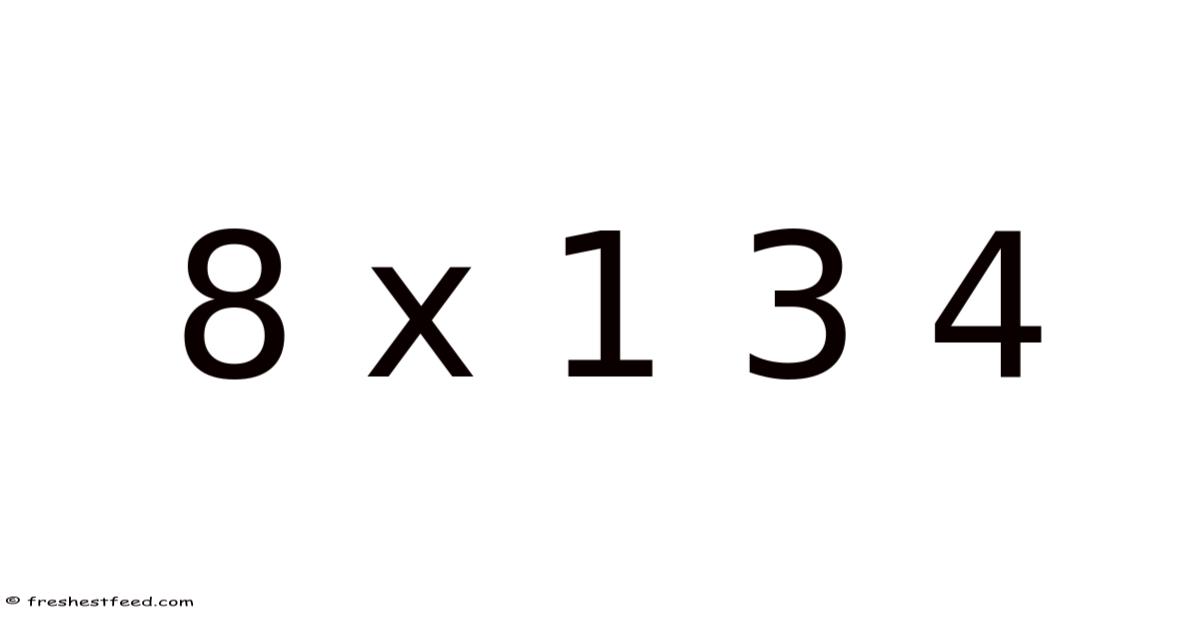
Decoding the Mystery: A Deep Dive into 8 x 1 3/4
The seemingly simple expression "8 x 1 3/4" might initially appear straightforward, but it opens a door to a fascinating exploration of fractions, decimals, and practical applications in various fields. This article will dissect this calculation, revealing its underlying mathematical principles and showcasing its relevance in everyday life, from carpentry to cooking, and even finance. We'll tackle different approaches to solving the problem, addressing potential confusion and providing a comprehensive understanding for all levels of mathematical proficiency The details matter here. No workaround needed..
Counterintuitive, but true.
Understanding the Fundamentals: Fractions and Mixed Numbers
Before diving into the calculation itself, let's review the fundamental concepts involved. The expression "1 3/4" represents a mixed number, combining a whole number (1) and a proper fraction (3/4). Here's the thing — this means we have one whole unit and three-quarters of another. To perform the multiplication, it's beneficial to convert this mixed number into an improper fraction.
To convert 1 3/4 to an improper fraction, we multiply the whole number (1) by the denominator (4), add the numerator (3), and then place the result over the original denominator:
(1 x 4) + 3 = 7
That's why, 1 3/4 is equivalent to 7/4.
Method 1: Multiplication with Improper Fractions
Now that we've converted the mixed number, the calculation becomes:
8 x 7/4
To multiply fractions, we simply multiply the numerators together and the denominators together:
(8 x 7) / (1 x 4) = 56/4
Finally, we simplify the resulting improper fraction by dividing the numerator by the denominator:
56 / 4 = 14
That's why, 8 x 1 3/4 = 14 Not complicated — just consistent..
Method 2: Distributive Property
Another approach utilizes the distributive property of multiplication. We can break down the multiplication as follows:
8 x (1 + 3/4) = (8 x 1) + (8 x 3/4)
This simplifies to:
8 + (24/4) = 8 + 6 = 14
This method demonstrates the flexibility of mathematical operations and showcases how different approaches can lead to the same correct answer.
Method 3: Decimal Conversion
A third approach involves converting the mixed number into a decimal. Consider this: 75 (since 3 divided by 4 equals 0. We know that 3/4 is equivalent to 0.Also, 75). So, 1 3/4 is equal to 1.75 Which is the point..
8 x 1.75 = 14
This method highlights the interchangeability between fractions and decimals and demonstrates the ease of multiplication using decimal numbers And that's really what it comes down to. Simple as that..
Real-World Applications: Where 8 x 1 3/4 Shows Up
The calculation 8 x 1 3/4 is not merely an abstract mathematical exercise; it frequently appears in real-world scenarios. Here are a few examples:
-
Carpentry and Construction: Imagine you need to cut eight pieces of wood, each measuring 1 3/4 feet long. The total length of wood required would be 8 x 1 3/4 = 14 feet. This calculation is crucial for accurate material estimation and efficient project planning Surprisingly effective..
-
Cooking and Baking: Recipes often involve fractional measurements. If a recipe calls for 1 3/4 cups of flour per serving and you're making eight servings, you'll need 8 x 1 3/4 = 14 cups of flour. Precision in measurements is essential for successful culinary endeavors.
-
Finance and Budgeting: Consider scenarios involving hourly wages. If you earn $1.75 per hour and work eight hours, your total earnings will be 8 x $1.75 = $14. This type of calculation is fundamental in personal finance management and payroll calculations Surprisingly effective..
-
Sewing and Fabric Cutting: Tailors and seamstresses frequently work with fractional measurements. If a pattern requires 1 3/4 yards of fabric for each garment, and you need to make eight garments, you will need a total of 14 yards of fabric It's one of those things that adds up..
-
Engineering and Design: In many engineering applications, precise measurements are crucial. Calculations involving fractions are essential for ensuring accuracy and functionality of designs.
Addressing Common Challenges and Misconceptions
While the calculation itself is relatively simple, certain misconceptions can arise, particularly among those less familiar with fractional arithmetic:
-
Incorrect Conversion to Improper Fraction: A common mistake is incorrectly converting the mixed number 1 3/4 to an improper fraction. Remembering the steps – multiply the whole number by the denominator, add the numerator, and place the result over the denominator – is crucial to avoid errors.
-
Difficulty with Fraction Multiplication: Multiplying fractions can sometimes be challenging. Remember that you multiply the numerators separately and the denominators separately, then simplify the resulting fraction if possible.
-
Order of Operations: If the expression is part of a larger calculation involving multiple operations (addition, subtraction, multiplication, division), remembering the order of operations (PEMDAS/BODMAS) is vital to ensure accuracy.
Frequently Asked Questions (FAQ)
-
Can I solve this using a calculator? Yes, absolutely! Most calculators can handle both fractions and decimals, making the calculation straightforward. Even so, understanding the underlying principles is important for problem-solving in situations where a calculator isn't available.
-
What if the number 8 was a fraction as well? The same principles apply. You would simply multiply the numerators together and the denominators together, then simplify the resulting fraction That's the part that actually makes a difference..
-
Are there other methods to solve this? Yes, there are other mathematical techniques, particularly involving algebra, that can be employed, but the methods described above are generally the most straightforward and readily accessible Practical, not theoretical..
-
Why is it important to understand this type of calculation? Understanding fraction and decimal arithmetic is fundamental to many aspects of life, from everyday tasks to professional fields. It builds a strong foundation for more advanced mathematical concepts.
Conclusion: Mastering the Fundamentals
The seemingly simple calculation of 8 x 1 3/4 serves as a gateway to understanding fundamental mathematical concepts. Through this detailed exploration, we’ve demonstrated various methods for solving the problem, highlighting the flexibility and interconnectedness of fractions and decimals. Understanding these principles is not just about getting the right answer; it's about developing crucial problem-solving skills applicable across numerous disciplines. By mastering these fundamental calculations, you build a stronger foundation for tackling more complex mathematical challenges in the future. Worth adding: remember the importance of understanding the underlying principles, even when using calculators, to enhance your mathematical proficiency and problem-solving capabilities. The ability to accurately and efficiently perform calculations involving fractions and decimals is a valuable skill applicable to various aspects of life and professional work.
