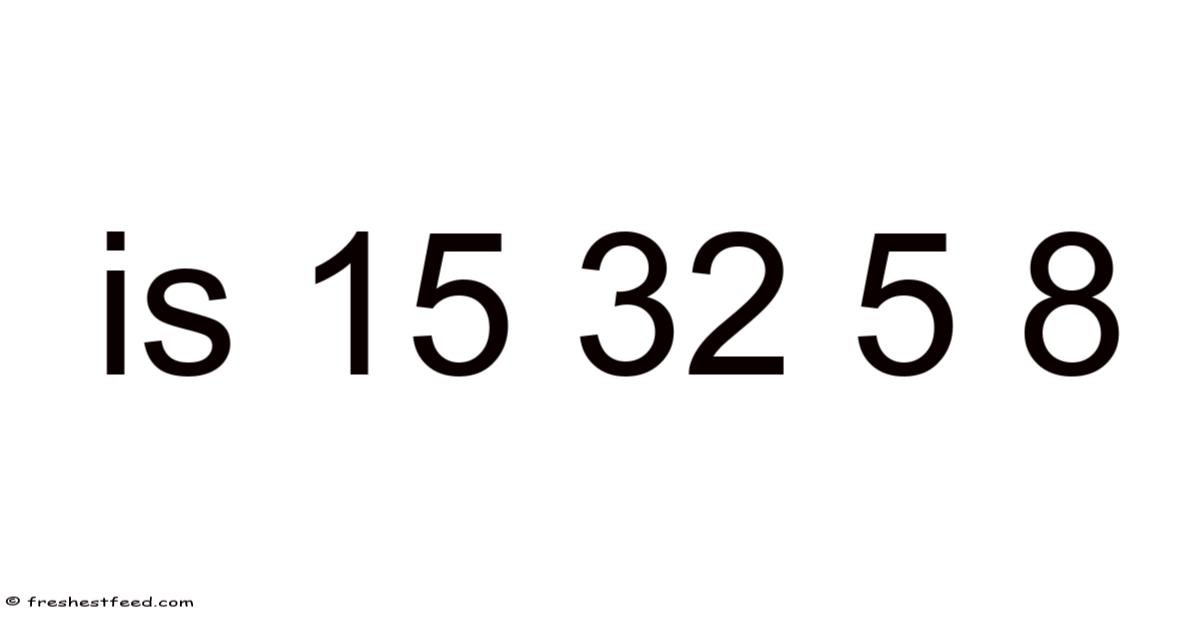
Decoding the Sequence: Is 15 32 5 8 a Code, a Puzzle, or Something More?
The sequence "15 32 5 8" might seem like a random collection of numbers at first glance. This article delves deep into various potential interpretations of this sequence, exploring mathematical patterns, cryptographic possibilities, and the importance of context in deciphering numerical sequences. Even so, depending on the context, it could represent a code, a puzzle, or even a set of data points waiting to be interpreted. We'll explore methods for pattern recognition, the application of different mathematical principles, and ultimately, the limitations of solving such sequences without further information That's the part that actually makes a difference..
Exploring Potential Patterns and Relationships
Before jumping to conclusions, let's systematically explore possible mathematical relationships between these numbers. We can investigate several avenues:
1. Arithmetic Progressions and Differences:
A simple approach is to check for arithmetic progressions—sequences where the difference between consecutive terms is constant. Still, unfortunately, calculating the differences between consecutive terms in "15 32 5 8" yields -17, 27, and -3, revealing no consistent pattern. This rules out a simple arithmetic progression Nothing fancy..
2. Geometric Progressions and Ratios:
Geometric progressions involve a constant ratio between consecutive terms. Consider this: again, calculating the ratios (32/15 ≈ 2. 13, 5/32 ≈ 0.Here's the thing — 16, 8/5 = 1. 6) shows no consistent pattern, eliminating this possibility.
3. Polynomial Relationships:
More complex relationships might exist. We could attempt to fit a polynomial function to these four data points. Even so, with only four points, we could fit a cubic polynomial perfectly, but this wouldn't necessarily reveal a meaningful underlying pattern. On top of that, such a fit would be purely descriptive and may not be predictive or insightful. Without further data points, a polynomial approach offers limited value.
4. Modular Arithmetic and Remainders:
Exploring modular arithmetic could reveal hidden patterns. Here's a good example: we can consider the remainders when each number is divided by a particular integer. Let's test a few common divisors:
- Modulo 2: 15 % 2 = 1, 32 % 2 = 0, 5 % 2 = 1, 8 % 2 = 0. This doesn't show a clear pattern.
- Modulo 3: 15 % 3 = 0, 32 % 3 = 2, 5 % 3 = 2, 8 % 3 = 2. While there's a slight pattern (two 2's), it's not conclusive.
- Modulo 4: 15 % 4 = 3, 32 % 4 = 0, 5 % 4 = 1, 8 % 4 = 0. No discernible pattern emerges.
Modular arithmetic doesn't immediately reveal an obvious underlying structure Turns out it matters..
5. Fibonacci-like Sequences:
While not a strict Fibonacci sequence, we could explore whether the numbers bear any resemblance to a Fibonacci-like sequence where each number is the sum of the previous two (or some variation thereof). In this case, the sequence doesn't fit this pattern either.
Beyond Simple Mathematical Patterns: Considering Context and Cryptography
The lack of straightforward mathematical relationships suggests we may need to consider alternative explanations. The sequence's meaning is highly dependent on the context in which it was presented.
1. Cryptographic Codes:
The numbers could be part of a code, perhaps using a substitution cipher where each number represents a letter or symbol. Still, without a key or further information about the cipher used, deciphering this code is virtually impossible. To break a code, we need more data points or clues And it works..
2. Data Points with Unknown Units:
The sequence could be a set of measurements or data points. On the flip side, without knowing the units involved (e.On the flip side, g. , temperature, weight, distance), interpretation is impossible. Context is crucial in understanding data; units provide the framework for meaningful interpretation.
3. Part of a Larger Sequence:
The sequence "15 32 5 8" might be a fragment of a longer sequence. A more extensive sequence might reveal a more apparent pattern or structure that remains hidden with only four numbers.
4. A Simple Puzzle with a Trick:
It's also possible that the sequence is part of a puzzle with a deceptive element or a trick. The solution might involve a non-mathematical approach, such as a word puzzle or a riddle where the numbers serve as clues to a different solution.
The Importance of Context and Further Information
Without additional context or information, definitively interpreting the sequence "15 32 5 8" is extremely difficult, if not impossible. To provide a meaningful interpretation, we need answers to crucial questions such as:
- Where did this sequence originate? Was it found in a mathematical problem, a cryptographic message, or some other context?
- What are the surrounding elements? Are there other related sequences or clues?
- What is the expected outcome or solution? Are we looking for a mathematical pattern, a code decryption, or something else?
- What is the intended audience? Is this a problem for mathematicians, cryptographers, or a general audience?
Conclusion: The Limits of Interpretation without Context
While we explored several mathematical and cryptographic possibilities, the lack of context severely limits our ability to interpret the sequence "15 32 5 8.Further information is absolutely essential to unravel the mystery behind this intriguing number sequence. Because of that, " This underscores the fundamental importance of contextual information in problem-solving and pattern recognition. The sequence could represent anything from a simple, undiscovered mathematical curiosity to a complex code or a piece of a larger puzzle. The ambiguity highlights the need for thorough consideration of surrounding information when attempting to decipher sequences or solve problems. Without it, "15 32 5 8" remains an enigmatic collection of numbers, open to various—and possibly countless—interpretations And it works..
