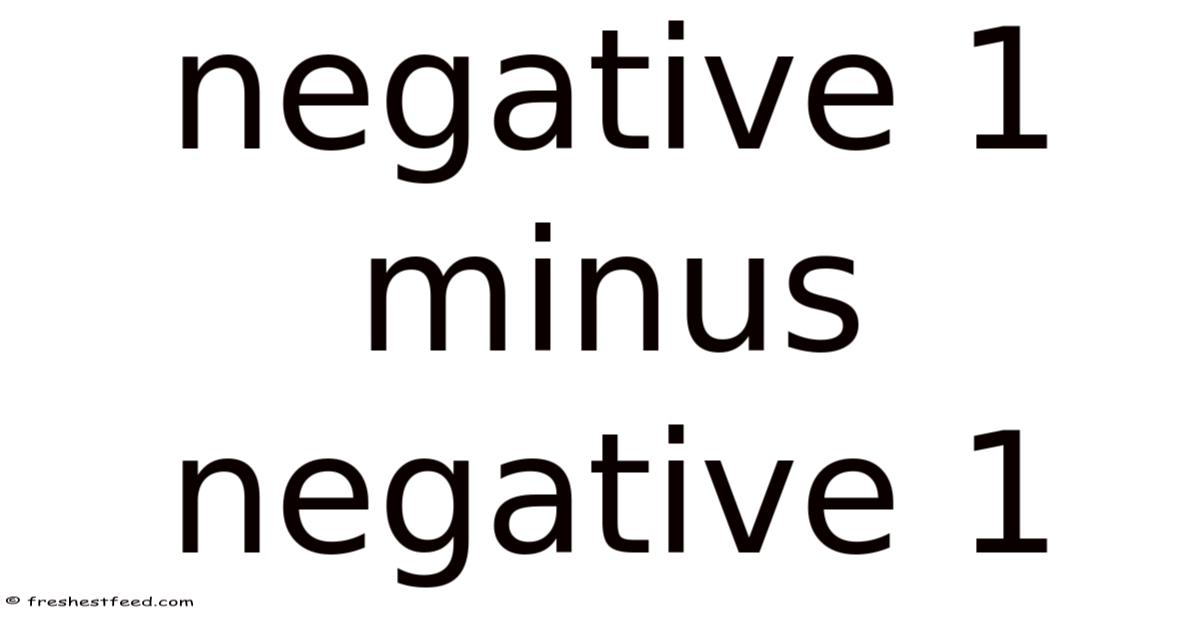
Decoding the Mystery: Negative One Minus Negative One (-1 - -1)
Understanding the nuances of negative numbers can be a stumbling block for many, even for those comfortable with basic arithmetic. This seemingly simple equation, -1 - -1, often causes confusion. This article will delve deep into the concept of subtracting negative numbers, explaining the mechanics behind the solution and exploring the broader mathematical principles at play. Consider this: we will break down the process step-by-step, providing clear explanations and addressing frequently asked questions to ensure a thorough understanding. By the end, you'll not only know the answer to -1 - -1 but also grasp the underlying concepts that govern operations with negative numbers Not complicated — just consistent..
Understanding Negative Numbers: A Foundation
Before tackling the equation, let's establish a firm grasp on negative numbers. Worth adding: negative numbers represent values less than zero. They are often used to represent quantities like debt, temperature below freezing, or positions below a reference point. Think of a number line: zero is the center, positive numbers extend to the right, and negative numbers extend to the left Most people skip this — try not to..
Not the most exciting part, but easily the most useful.
The key to understanding operations with negative numbers is to remember their relationship to their positive counterparts. A negative number essentially represents the opposite of its positive equivalent. Here's a good example: -5 is the opposite of +5, meaning it's five units to the left of zero on the number line.
Honestly, this part trips people up more than it should.
The Double Negative: A Crucial Concept
The core of solving -1 - -1 lies in understanding the concept of subtracting a negative number. Subtracting a negative number is equivalent to adding its positive counterpart. Consider this: this is often summarized by the phrase "two negatives make a positive. " While a simplification, it encapsulates a crucial mathematical truth.
Let's illustrate this with a real-world example. If that debt is removed or subtracted (-), you essentially gain $1. Day to day, imagine you owe someone $1 (represented as -1). Removing a debt is the same as receiving money, hence subtracting a negative results in a positive Worth knowing..
Mathematically, we can represent this as follows: a - (-b) = a + b. This rule applies universally regardless of the values of 'a' and 'b'.
Solving -1 - -1: A Step-by-Step Approach
Now, let's apply this knowledge to our equation: -1 - -1.
-
Identify the double negative: We see two consecutive negative signs: - -.
-
Apply the rule: According to the rule established above, subtracting a negative number is the same as adding its positive counterpart. Which means, - -1 becomes +1.
-
Rewrite the equation: Our equation now transforms from -1 - -1 to -1 + 1 The details matter here..
-
Perform the addition: This is a simple addition problem: -1 + 1 = 0 Most people skip this — try not to..
That's why, the solution to -1 - -1 is 0.
Visualizing the Solution on a Number Line
A number line provides a visual representation of this operation, making the concept even clearer.
-
Start at -1: Place your finger at -1 on the number line.
-
Subtract -1: Subtracting -1 means moving to the right on the number line by one unit (remember, subtracting a negative is equivalent to adding a positive).
-
Reach the result: Your finger will land on 0, confirming our solution.
Expanding the Concept: Beyond -1 - -1
The principle of "two negatives make a positive" applies broadly to all subtractions involving negative numbers. Consider these examples:
- 5 - (-3): This becomes 5 + 3 = 8
- -7 - (-2): This becomes -7 + 2 = -5
- -10 - (-10): This becomes -10 + 10 = 0
Notice the pattern: in each case, the subtraction of a negative number transforms the operation into an addition, leading to a simpler calculation The details matter here..
The Importance of Parentheses in Mathematical Expressions
Parentheses play a crucial role in determining the order of operations and the interpretation of mathematical expressions. The parentheses clarify that the subtraction applies to the entire negative value. That said, we can rewrite the expression as -1 + (-1 * -1). Now, in the case of -1 - -1, the parentheses are implicitly present, even if they are not explicitly written. This emphasis is critical when dealing with more complex expressions Small thing, real impact..
- -(1 - 1): Here, the negative sign applies to the entire expression (1 - 1), resulting in -(0) = 0.
- -1 - 1: Here, the negative sign applies only to the first '1', resulting in -2.
The proper use of parentheses is crucial for accuracy in mathematics, especially when dealing with multiple operations and negative numbers.
The Connection to Additive Inverses
The concept of subtracting negative numbers is intrinsically linked to the mathematical concept of additive inverses. The additive inverse of a number is the number that, when added to the original number, results in zero. For example:
- The additive inverse of 5 is -5 (5 + (-5) = 0)
- The additive inverse of -3 is 3 (-3 + 3 = 0)
Subtracting a number is the same as adding its additive inverse. So, subtracting -1 is the same as adding its additive inverse, which is +1. This provides another perspective on why subtracting a negative results in a positive Worth keeping that in mind. That alone is useful..
Frequently Asked Questions (FAQ)
Q1: Why does subtracting a negative number result in addition?
A1: Subtraction is essentially the inverse operation of addition. Subtracting a negative number is like "undoing" the act of taking away a negative value. This "undoing" is equivalent to adding its positive counterpart.
Q2: Is there a different way to solve -1 - -1 besides the "two negatives make a positive" rule?
A2: Yes, you can visualize it on a number line, as described earlier. Alternatively, you can think of it in terms of additive inverses. Subtracting -1 is equivalent to adding its additive inverse, which is +1.
Q3: What if I have more than two consecutive negative signs?
A3: Each pair of consecutive negative signs cancels out and becomes a positive sign. Here's a good example: ---1 simplifies to -1, and ----1 simplifies to +1 Worth keeping that in mind..
Q4: How can I avoid making mistakes when working with negative numbers?
A4: Practice regularly with various examples. Use a number line to visualize the operations, and pay careful attention to parentheses to ensure correct order of operations.
Conclusion: Mastering Negative Numbers
Understanding negative numbers and their operations is fundamental to a solid grasp of mathematics. And this principle, coupled with a clear understanding of additive inverses and the careful use of parentheses, equips you to confidently tackle more complex mathematical expressions involving negative numbers. Also, with dedication, you'll transform this initially perplexing concept into a fundamental piece of your mathematical toolkit. While the equation -1 - -1 might seem simple, it reveals a crucial principle: subtracting a negative number is equivalent to adding its positive counterpart. Remember the steps, visualize the process using a number line, and practice consistently. The solution to -1 - -1 is 0, but the understanding gained extends far beyond this single equation, providing a firm foundation for more advanced mathematical explorations.
