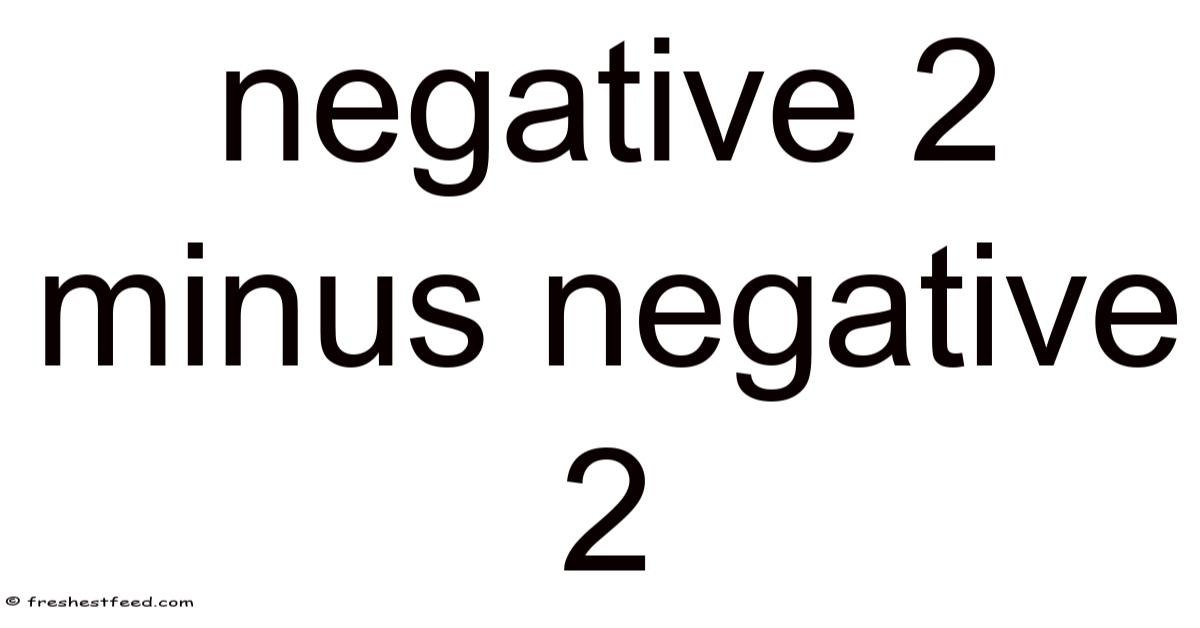
Decoding the Mystery: Negative Two Minus Negative Two (-2 - (-2))
Understanding basic arithmetic, particularly operations involving negative numbers, forms the foundation of more complex mathematical concepts. This article dives deep into the seemingly simple equation, -2 - (-2), explaining not only the solution but also the underlying principles and common misconceptions. We'll explore the rules of integers, offer various approaches to solving this problem, and provide a solid understanding that will equip you to tackle similar problems with confidence.
Introduction: Navigating the World of Negative Numbers
Negative numbers often cause confusion, especially when combined with subtraction. The expression "-2 - (-2)" might seem daunting at first glance, but breaking it down step-by-step reveals a straightforward solution. So this article aims to demystify this concept, clarifying the rules and providing a thorough explanation that goes beyond simply providing the answer. We'll cover the fundamental principles of integer arithmetic and demonstrate multiple methods to solve the problem, catering to diverse learning styles.
Understanding the Rules of Integer Arithmetic
Before tackling the problem directly, let's review the fundamental rules governing operations with integers (positive and negative whole numbers):
-
Addition of Integers: When adding integers with the same sign, add their absolute values and keep the common sign. When adding integers with opposite signs, subtract the smaller absolute value from the larger absolute value and keep the sign of the number with the larger absolute value.
-
Subtraction of Integers: Subtracting an integer is equivalent to adding its opposite. This is a crucial concept for understanding the problem at hand. To subtract a number, we add its additive inverse (its opposite).
-
Additive Inverse: The additive inverse of a number is the number that, when added to the original number, results in zero. Here's one way to look at it: the additive inverse of 2 is -2, and the additive inverse of -5 is 5 No workaround needed..
Solving -2 - (-2): A Step-by-Step Approach
Now, let's apply these rules to solve -2 - (-2):
-
Identify the Operation: The main operation is subtraction.
-
Apply the Rule of Subtraction: Remember, subtracting a number is the same as adding its additive inverse. Because of this, -2 - (-2) can be rewritten as -2 + (+2) Less friction, more output..
-
Perform the Addition: Now we have a simple addition problem: -2 + 2. Since the numbers have opposite signs, we subtract their absolute values (2 - 2 = 0).
-
Determine the Sign: The result is 0. Zero is neither positive nor negative.
So, -2 - (-2) = 0
Visualizing the Solution: The Number Line
Using a number line can help visualize the process:
-
Start at -2: Place your finger on -2 on the number line.
-
Subtract -2: Subtracting a negative number means moving to the right on the number line. We move two units to the right.
-
The Result: Your finger will land on 0.
This visual representation reinforces the concept that subtracting a negative number is equivalent to adding a positive number Easy to understand, harder to ignore..
Alternative Approaches and Explanations
While the method above is the most straightforward, let's explore alternative approaches to solidify our understanding:
1. Using the concept of 'debt' and 'credit':
Imagine you have a debt of $2 (-$2). Then, someone cancels a debt of $2 (-(-$2)). The net result is that you have no debt, which is $0.
2. Using algebraic properties:
We can put to use the associative property of addition to rearrange the equation: -2 - (-2) can be thought of as (-2) + (-(-2)). Since -(-2) = +2, this simplifies to (-2) + 2 = 0.
3. Using a table:
A simple table can help track the changes:
| Starting Point | Operation | Result |
|---|---|---|
| -2 | Subtract -2 | 0 |
Addressing Common Misconceptions
Several common misconceptions surround operations with negative numbers. Let's address some of them:
-
"Two negatives make a positive": While this phrase is often used as a shortcut, it's crucial to understand why two negatives result in a positive. It's not merely a rule, but a consequence of the definition of subtraction and the additive inverse.
-
Confusing subtraction with negation: Subtraction is an operation between two numbers. Negation is simply changing the sign of a number. These are distinct concepts The details matter here..
-
Ignoring order of operations: In more complex expressions, remember to follow the order of operations (PEMDAS/BODMAS) Easy to understand, harder to ignore..
Frequently Asked Questions (FAQ)
-
Q: What if the problem was -2 + (-2)?
A: In this case, we're adding two negative numbers. Adding numbers with the same sign means adding their absolute values and keeping the negative sign. So, -2 + (-2) = -4.
-
Q: How does this apply to more complex equations?
A: The principles discussed here form the foundation for solving more complex algebraic equations. Mastering the fundamentals of integer arithmetic is crucial for tackling more advanced problems.
-
Q: Are there any real-world applications of this concept?
A: Yes! Negative numbers are used extensively in various fields like finance (debt, losses), temperature (below zero), and even in physics (velocity, displacement).
Conclusion: Mastering Integer Arithmetic
Understanding operations involving negative numbers is essential for success in mathematics and numerous real-world applications. Which means the seemingly simple problem, -2 - (-2), serves as an excellent illustration of fundamental principles like the additive inverse and the equivalence of subtracting a negative number to adding a positive. Worth adding: by mastering these concepts and employing various problem-solving approaches, you'll build a solid foundation for more advanced mathematical concepts. Even so, remember to practice regularly and visualize the operations to solidify your understanding. Now, the key is not just memorizing rules but understanding the underlying reasoning. With consistent effort and practice, you’ll confidently figure out the world of negative numbers and get to a deeper understanding of mathematics Turns out it matters..
