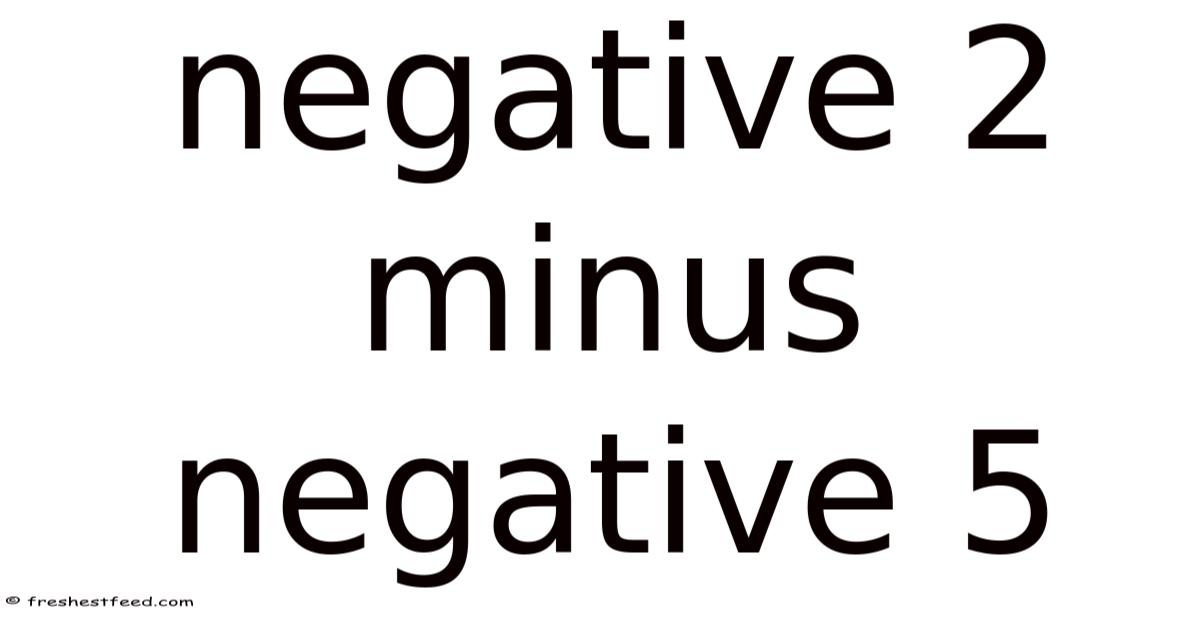
Deconstructing -2 - (-5): A Deep Dive into Integer Subtraction
This article explores the seemingly simple mathematical problem of -2 - (-5), providing a comprehensive understanding of integer subtraction, its underlying principles, and practical applications. We'll move beyond a simple answer and look at the conceptual framework that allows us to solve this and similar problems with confidence. This will involve exploring the number line, the concept of opposites, and different approaches to solving such problems. Understanding integer operations is crucial for success in algebra, calculus, and many other mathematical and scientific fields.
Introduction: Understanding Negative Numbers
Before tackling -2 - (-5), let's build a solid foundation. The number line extends infinitely in both positive and negative directions, with zero at the center. Visualizing negative numbers on a number line is extremely helpful. They're often used to represent things like debt, temperature below freezing, or a decrease in quantity. Negative numbers represent values less than zero. Numbers to the right of zero are positive, and numbers to the left are negative.
The Concept of Subtraction: Taking Away vs. Adding the Opposite
Subtraction, at its core, represents the removal of a quantity from another. Even so, when dealing with negative numbers, the intuitive concept of "taking away" can become confusing. A more reliable understanding involves the concept of "adding the opposite.
Instead of thinking of subtraction as "taking away," consider it as "adding the additive inverse." The additive inverse of a number is simply its opposite. In real terms, the additive inverse of 5 is -5, and the additive inverse of -5 is 5. This principle allows us to rewrite any subtraction problem as an addition problem. The rule is: a - b = a + (-b) Most people skip this — try not to..
Solving -2 - (-5) Step-by-Step
Now, let's apply this principle to our problem: -2 - (-5).
-
Rewrite as Addition: Following the rule, we rewrite the subtraction as addition of the opposite: -2 + (+5). Notice how the double negative (-(-5)) becomes a positive (+5). This is a key concept in understanding integer operations. The minus sign in front of the parentheses acts as a multiplier, essentially multiplying -1 by -5, which results in +5.
-
Visualizing on the Number Line: Imagine starting at -2 on the number line. Adding +5 means moving five units to the right (because positive numbers represent movement to the right).
-
The Solution: Starting at -2 and moving five units to the right brings us to +3. Because of this, -2 - (-5) = 3 Simple, but easy to overlook..
Different Methods to Solve: A Comparative Analysis
While the "add the opposite" method is generally preferred for its clarity and consistency, let's explore a few other approaches:
-
Number Line Method (Visual): As shown above, this method uses the number line to visually represent the operation. It's excellent for beginners as it provides a concrete visual representation of the problem Simple, but easy to overlook..
-
Chip Model (Concrete): This method uses colored chips to represent positive and negative numbers. Red chips could represent negative numbers, and blue chips could represent positive numbers. You would start with two red chips (-2) and then remove five red chips. Since you don't have five red chips to remove, you introduce five pairs of red and blue chips (which represent zero, as they cancel each other out). You then remove five red chips, leaving three blue chips, representing +3. This method is particularly useful for kinesthetic learners.
-
Absolute Value and Sign Method: This method involves finding the difference between the absolute values of the numbers and then assigning the sign based on which number has the larger absolute value. The absolute value of -2 is 2, and the absolute value of -5 is 5. The difference is 5 - 2 = 3. Since the number with the larger absolute value (-5) is negative, the result is -3. This, however, is incorrect when applied to subtraction directly. It only works for addition. For subtraction, we must use the "add the opposite" method That's the whole idea..
The Importance of Understanding the Underlying Principles
Understanding the "add the opposite" rule is vital because it extends beyond simple integer subtraction. It forms the basis for more complex algebraic manipulations involving variables and expressions. Take this case: simplifying expressions like (x - (-y)) becomes (x + y) Surprisingly effective..
Expanding the Concept: More Complex Problems
Let's consider more complex scenarios to solidify our understanding:
-
-7 - (-3): This becomes -7 + 3 = -4. We start at -7 on the number line and move three units to the right That's the part that actually makes a difference..
-
-10 - (-15): This becomes -10 + 15 = 5. Starting at -10 and moving 15 units to the right.
-
5 - (-2): This becomes 5 + 2 = 7. Starting at 5 and moving two units to the right Small thing, real impact..
Notice a pattern? When subtracting a negative number, the result is always equivalent to adding the positive equivalent of that number. This reinforces the "add the opposite" rule Took long enough..
Frequently Asked Questions (FAQ)
-
Q: Why does subtracting a negative number result in addition? A: Subtracting a number is the same as adding its opposite. The opposite of a negative number is a positive number Took long enough..
-
Q: Can I use a calculator for these problems? A: Yes, calculators can handle integer subtraction. Even so, it's crucial to understand the underlying principles to solve problems without relying solely on a calculator, especially when dealing with more complex algebraic expressions.
-
Q: Are there any real-world applications of integer subtraction? A: Absolutely! Examples include calculating changes in temperature (e.g., the difference between -5°C and -2°C), tracking financial transactions (e.g., calculating the net change in a bank account after withdrawals and deposits), and determining changes in altitude Less friction, more output..
-
Q: What if I encounter more than two negative numbers in a subtraction problem? A: Apply the "add the opposite" rule sequentially. Here's one way to look at it: -2 - (-5) - (-3) becomes -2 + 5 + 3 = 6.
Conclusion: Mastering Integer Subtraction
Mastering integer subtraction is a foundational skill in mathematics. This understanding will not only help you solve problems correctly but will also enhance your problem-solving skills in a wider range of mathematical contexts. Consider this: by understanding the concept of adding the opposite and practicing different solution methods, you can build a strong foundation for more advanced mathematical concepts. Think about it: don't hesitate to practice various examples and visualize the process using a number line or other methods until the concept becomes second nature. Which means remember, the key is not just memorizing the rules but understanding the underlying principles that govern these operations. With consistent effort, you'll confidently figure out the world of integers and their operations Which is the point..
