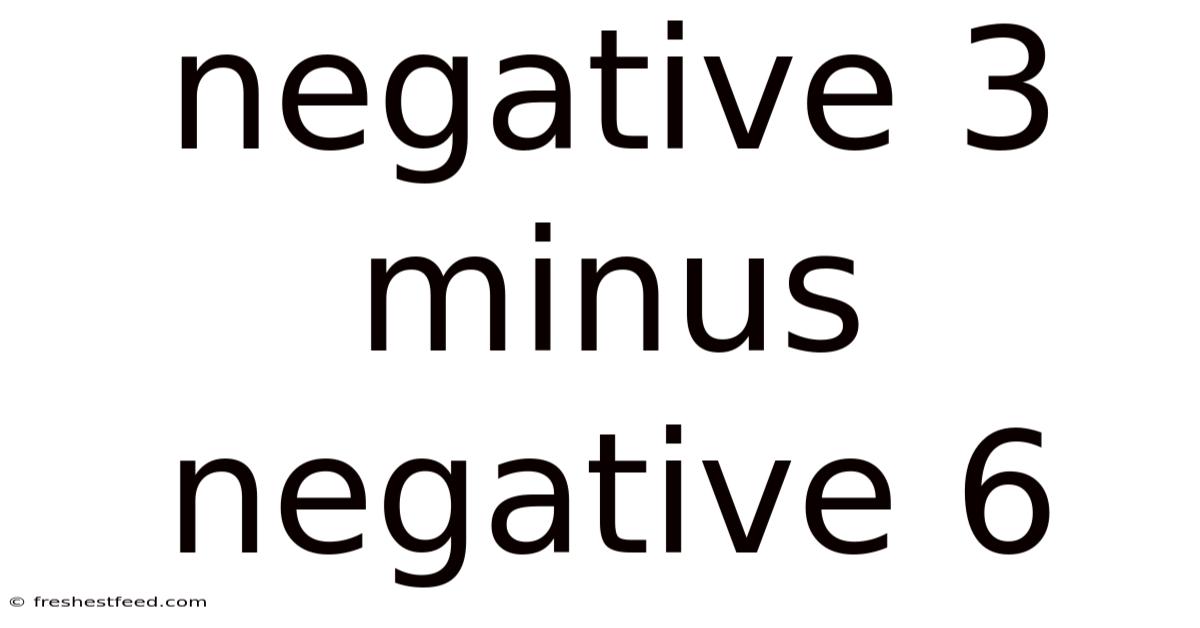
Unraveling the Mystery: Negative 3 Minus Negative 6
Understanding the concept of subtracting negative numbers can be tricky, even for those comfortable with basic arithmetic. We'll explore the intricacies of negative numbers, dig into the rules of subtraction, and offer various approaches to tackle this type of problem, ensuring a clear and lasting understanding. Worth adding: this thorough look will illuminate the process of solving "-3 - (-6)," explaining not only the solution but also the underlying mathematical principles. This article will serve as a valuable resource for students, educators, and anyone seeking to solidify their grasp of fundamental arithmetic Worth keeping that in mind. Nothing fancy..
Understanding Negative Numbers
Before diving into the problem, let's establish a firm foundation in understanding negative numbers. Negative numbers represent values less than zero. Consider this: they are often used to represent things like debt, temperature below freezing, or positions below a reference point. On a number line, negative numbers are located to the left of zero. The further a number is from zero to the left, the smaller its value Practical, not theoretical..
Think of a number line extending infinitely in both positive and negative directions. Zero sits perfectly in the middle. To the right, you have positive numbers (1, 2, 3, and so on), and to the left, you have negative numbers (-1, -2, -3, and so on) Simple, but easy to overlook..
The Rules of Subtraction
Subtraction is essentially the inverse operation of addition. In practice, this concept is crucial for understanding how to subtract negative numbers. When we subtract a number, we are essentially adding its opposite. The opposite of a number is its additive inverse.
And yeah — that's actually more nuanced than it sounds.
- The opposite of 5 is -5.
- The opposite of -5 is 5.
This leads us to a critical rule: subtracting a negative number is the same as adding a positive number. This is the key to solving our problem, "-3 - (-6)."
Solving -3 - (-6) : Step-by-Step Approach
Now, let's break down the solution to "-3 - (-6)" using the principles discussed above Easy to understand, harder to ignore. That's the whole idea..
Step 1: Rewrite the subtraction as addition of the opposite.
The expression "-3 - (-6)" can be rewritten as "-3 + (+6)." Remember, subtracting a negative is equivalent to adding a positive.
Step 2: Perform the addition.
Now we have a simple addition problem: -3 + 6. Consider this: imagine this on the number line. We start at -3 and move six units to the right (because we're adding a positive number). This brings us to the number 3 Took long enough..
Step 3: State the solution.
Because of this, -3 - (-6) = 3.
Visualizing the Solution on a Number Line
Using a number line is a fantastic way to visualize this operation. Start at -3. Subtracting -6 means moving six units to the right (the opposite direction of a negative movement). On the flip side, this lands you at 3. This visual representation reinforces the concept of adding the opposite And it works..
Alternative Approaches to Solving the Problem
While the method outlined above is the most straightforward, there are alternative ways to approach this problem:
- Using the concept of absolute values: The absolute value of a number is its distance from zero. The absolute value of -3 is 3, and the absolute value of -6 is 6. In this case, you would find the difference between the absolute values (6 - 3 = 3), and then consider the sign of the larger absolute value (which is positive, because 6 > 3). Because of this, the result is 3. This approach works well but requires a clear understanding of absolute value and sign rules.
- Breaking it down into smaller steps: Some students find it easier to break the problem down. For example: They might first solve -3 + 3, which equals 0. Then they add the remaining 3 (from the original -6), resulting in a final answer of 3. This might seem more complicated, but it can be a helpful visualization tool for some learners.
The Importance of Understanding the Underlying Principles
It’s crucial to stress the underlying principles rather than rote memorization. In practice, understanding why subtracting a negative number results in addition is far more valuable than simply memorizing the rule. This understanding lays the groundwork for more advanced mathematical concepts later on Simple as that..
Extending the Concept: More Complex Problems
The same principles apply to more complex problems involving multiple negative numbers. Here's a good example: consider the problem: "-5 - (-2) - (-4)."
Step 1: Rewrite the subtractions as additions of opposites:
-5 + (+2) + (+4)
Step 2: Perform the addition from left to right:
-5 + 2 = -3 -3 + 4 = 1
Step 3: State the solution:
Because of this, -5 - (-2) - (-4) = 1
Frequently Asked Questions (FAQ)
-
Q: Why does subtracting a negative become addition? A: Subtraction is the inverse of addition. Subtracting a negative number is the same as removing a debt. Removing a debt is equivalent to adding money (a positive value).
-
Q: Can I always change subtraction of a negative to addition? A: Yes, this is a fundamental rule in arithmetic. It’s a reliable way to simplify expressions involving negative numbers.
-
Q: What if I have more than two negative numbers? A: The same principle applies. Rewrite all subtractions of negative numbers as additions of their opposites, and then perform the addition from left to right.
-
Q: Is there a different way to remember the rule? A: Think of it as "two negatives make a positive." When you subtract a negative number, the two negative signs essentially cancel each other out, resulting in a positive value Which is the point..
Conclusion: Mastering Negative Numbers
Mastering the subtraction of negative numbers is a significant step in building a strong mathematical foundation. But through consistent practice and a clear grasp of the underlying concepts, negative numbers will cease to be a source of confusion and become another tool in your mathematical toolkit. In practice, by understanding the underlying principles, visualizing the operation on a number line, and practicing with various examples, you can confidently tackle any problem involving negative numbers. Remember, the key is to understand the concept of adding the opposite, a principle that transcends simple arithmetic and finds application in more advanced mathematical disciplines. The seemingly complex operation of "-3 - (-6)" ultimately reveals the beauty and logic inherent in mathematical operations.
