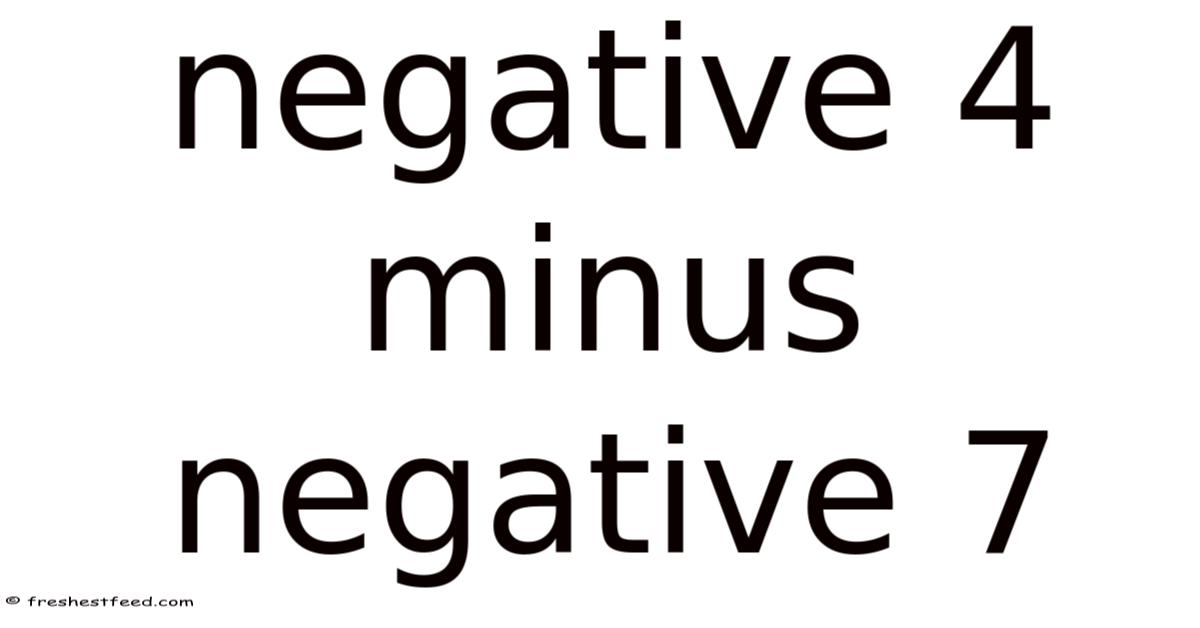
Decoding the Mystery: Negative 4 Minus Negative 7
Understanding integer arithmetic, particularly operations involving negative numbers, can be tricky. This article will delve deep into the seemingly simple calculation of -4 - (-7), explaining not just the answer but the underlying mathematical principles, providing practical examples, and addressing common misconceptions. Practically speaking, we'll explore the concept of subtracting negative numbers, connect it to real-world scenarios, and solidify your understanding with step-by-step explanations and frequently asked questions. By the end, you'll not only know the solution to -4 - (-7) but also possess a dependable grasp of negative number arithmetic.
People argue about this. Here's where I land on it.
Introduction: Navigating the World of Negative Numbers
Negative numbers represent values less than zero. That's why understanding how to perform operations with negative numbers is fundamental to mastering basic algebra and numerous scientific applications. They are crucial in various fields, from accounting (representing debt) to physics (representing temperature below zero). Even so, this article focuses on subtraction involving negative numbers, specifically tackling the problem: -4 - (-7). Many find this type of subtraction confusing, but by breaking it down step-by-step, we'll demystify the process.
Understanding Subtraction as Adding the Opposite
The key to understanding subtraction involving negative numbers lies in recognizing that subtracting a negative number is equivalent to adding its positive counterpart. Here's the thing — this is a fundamental principle in mathematics. Think of it this way: subtracting something negative is like removing a debt; it effectively increases your positive balance.
Let's illustrate this with a simple analogy. Because of that, imagine you owe someone $4 (represented as -4). If that debt is reduced by $7 (represented as -(-7)), your net debt decreases. This reduction in debt is equivalent to adding $7 to your financial position.
And yeah — that's actually more nuanced than it sounds.
Step-by-Step Solution: -4 - (-7)
Now let's apply this principle to our problem: -4 - (-7).
-
Identify the subtraction of a negative number: We see "- (-7)" The details matter here..
-
Rewrite the subtraction as addition of the opposite: Subtracting a negative number is the same as adding its positive counterpart. So, "- (-7)" becomes "+ 7" The details matter here..
-
Rewrite the expression: Our original problem -4 - (-7) now becomes -4 + 7 Most people skip this — try not to..
-
Perform the addition: We now have a simple addition problem: -4 + 7. Since 7 is larger than 4, the result will be positive. Subtracting 4 from 7 leaves 3.
-
Final Answer: Which means, -4 - (-7) = 3.
Visualizing the Solution: The Number Line
A number line can be a powerful tool for visualizing operations involving negative numbers. Let's use it to represent -4 - (-7):
-
Start at -4: Locate -4 on the number line.
-
Subtracting a negative is like adding a positive: Subtracting -7 means moving to the right (in the positive direction) on the number line by 7 units.
-
Arrive at the solution: After moving 7 units to the right from -4, you land on 3. This visually confirms that -4 - (-7) = 3 It's one of those things that adds up..
Real-World Applications: Where Negative Numbers Matter
Negative numbers aren't just abstract mathematical concepts; they have practical applications in many areas of life:
-
Temperature: Temperatures below zero are commonly represented with negative numbers (e.g., -5°C). If the temperature rises from -4°C to -(-7)°C, it increases by 3°C, reaching 3°C No workaround needed..
-
Finance: Negative numbers often represent debt or losses. Imagine a bank account with a balance of -$4. If a deposit of $7 is made, the balance increases by $7, resulting in a positive balance of $3.
-
Elevation: Negative numbers can represent elevations below sea level. If a submarine is at -4 meters and ascends 7 meters, its new elevation will be 3 meters above sea level.
Expanding the Understanding: Further Exploration of Integer Arithmetic
While we've focused on -4 - (-7), it's beneficial to understand the broader context of integer arithmetic. Here are some important principles:
-
Addition of integers: When adding integers with the same sign (both positive or both negative), add their absolute values and keep the original sign. When adding integers with opposite signs, subtract the smaller absolute value from the larger and keep the sign of the number with the larger absolute value.
-
Subtraction of integers: Subtraction is equivalent to adding the opposite. To subtract an integer, add its additive inverse (its opposite).
-
Multiplication and division of integers: When multiplying or dividing integers with the same sign, the result is positive. When multiplying or dividing integers with opposite signs, the result is negative.
Frequently Asked Questions (FAQ)
Q: Why is subtracting a negative number the same as adding a positive number?
A: This stems from the definition of subtraction and the properties of additive inverses. The additive inverse of -7 is +7. Still, subtracting a number is the same as adding its additive inverse (opposite). Because of this, -4 - (-7) is equivalent to -4 + 7.
Q: Can I use a calculator for this type of problem?
A: Yes, most calculators can handle operations with negative numbers. Simply input the expression -4 - (-7) and the calculator will correctly compute the result as 3 Simple, but easy to overlook. But it adds up..
Q: What if the numbers were different? How would I solve -8 - (-3)?
A: The same principles apply. -8 - (-3) becomes -8 + 3. The result is -5.
Q: Are there other ways to explain subtracting negative numbers?
A: Yes, some people find it helpful to think of removing a negative as "taking away a debt.Which means " Others prefer visualizing the movement on a number line. The most important thing is to find an explanation that makes sense to you and helps you consistently solve these types of problems.
Conclusion: Mastering Negative Number Arithmetic
Understanding how to subtract negative numbers is a cornerstone of mathematical proficiency. Think about it: by grasping the concept of subtracting a negative as adding its positive counterpart, you can confidently tackle problems involving negative integers. But we've explored the solution to -4 - (-7) in detail, using various methods to reinforce your understanding. Worth adding: remember to practice regularly to build confidence and fluency in integer arithmetic, ensuring you can apply this knowledge in various mathematical and real-world contexts. The ability to confidently perform operations with negative numbers opens doors to more complex mathematical concepts and a deeper understanding of the world around us.
