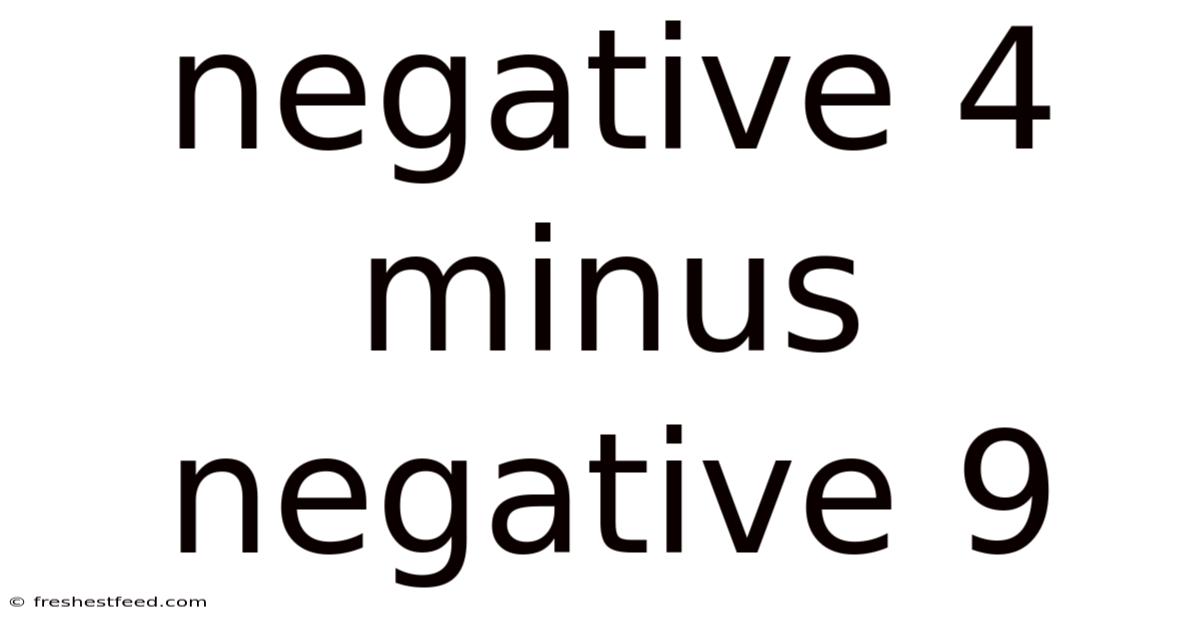
Deconstructing -4 - (-9): A Deep Dive into Integer Subtraction
Understanding integer subtraction, especially when dealing with negative numbers, can seem daunting at first. But this full breakdown will break down the seemingly complex problem of "-4 minus negative 9," or -4 - (-9), step-by-step, explaining the underlying principles and providing practical examples. We'll explore various methods for solving this type of problem, ensuring you not only get the correct answer but also develop a solid understanding of the concepts involved. By the end, you'll be confident in tackling similar problems and feel empowered to explain the process to others Still holds up..
Understanding Integer Subtraction
Before tackling -4 - (-9), let's solidify our understanding of integer subtraction. On top of that, subtraction, in its essence, means finding the difference between two numbers. Integers are whole numbers, including zero, positive numbers, and negative numbers. When subtracting a positive number, we move to the left on the number line. Still, subtracting a negative number introduces a crucial concept: the double negative Which is the point..
The Double Negative Rule: The Key to Solving -4 - (-9)
The core of solving -4 - (-9) lies in understanding the "double negative" rule. This rule states that subtracting a negative number is equivalent to adding its positive counterpart. In mathematical terms: -(-x) = +x.
This rule stems from the definition of subtraction itself. On top of that, subtraction can be viewed as the addition of the opposite. The opposite of a number is its additive inverse. The additive inverse of -9 is +9. Because of this, -4 - (-9) can be rewritten as -4 + 9.
Step-by-Step Solution of -4 - (-9)
Let's now solve -4 - (-9) using the double negative rule and visualizing it on a number line:
Step 1: Apply the Double Negative Rule
As explained above, -4 - (-9) becomes -4 + 9. We've transformed a subtraction problem involving negative numbers into an addition problem.
Step 2: Visualize on the Number Line
Imagine a number line. Start at -4. Adding 9 means moving 9 units to the right on the number line (since we are adding a positive number) The details matter here. Worth knowing..
Step 3: Perform the Addition
-4 + 9 = 5
Because of this, -4 - (-9) = 5.
Alternative Methods for Solving -4 - (-9)
While the double negative rule provides the most straightforward approach, let's explore some alternative methods to reinforce understanding:
Method 1: Using Absolute Values and Signs
- Find the difference between the absolute values: The absolute value of -4 is 4, and the absolute value of -9 is 9. The difference is 9 - 4 = 5.
- Determine the sign: Since the number with the larger absolute value (-9) is negative, the result will be positive. So, the answer is 5.
Method 2: Chip Model (Visual Representation)
Imagine representing numbers using chips. Red chips represent negative numbers, and black chips represent positive numbers.
- -4 is represented by 4 red chips.
- -(-9) is represented by removing 9 red chips. Since we only have 4 red chips, we add 5 black chips to make it possible to remove 9 red chips. This leaves us with 5 black chips.
This visual representation demonstrates how removing negative numbers is equivalent to adding positive ones.
Explanation using Additive Inverse and Number Line
We can further explain this operation by using the concept of the additive inverse and its visualization on a number line:
-
The additive inverse of a number is the number that, when added to the original number, results in zero. As an example, the additive inverse of -9 is 9, because -9 + 9 = 0 That's the part that actually makes a difference..
-
On a number line, subtracting a number is equivalent to moving to the left. Subtracting a negative number, therefore, is equivalent to moving to the right because we're essentially adding its additive inverse.
-
Starting at -4 on the number line and adding the additive inverse of -9 (which is 9), we move 9 units to the right, ending up at 5.
Real-World Applications of Integer Subtraction
Understanding integer subtraction is crucial in various real-world scenarios, some of which include:
- Finance: Calculating profit and loss, tracking bank balances (especially when considering overdrafts), and understanding financial transactions.
- Temperature: Determining the temperature difference between two readings. Take this: if the temperature dropped from -4°C to -9°C, the change in temperature is -9°C - (-4°C) = -5°C.
- Elevation: Calculating differences in elevation between two points, especially useful in geography, surveying, and hiking.
- Programming: Integer subtraction is fundamental in various programming tasks, from game development to data analysis.
Frequently Asked Questions (FAQ)
Q1: Why does subtracting a negative number result in addition?
A1: Subtracting a number is the same as adding its opposite. The opposite of a negative number is a positive number.
Q2: Can I use a calculator to solve -4 - (-9)?
A2: Yes, most calculators will correctly handle this operation. Ensure your calculator is correctly interpreting the negative signs Took long enough..
Q3: What if I have more complex problems involving multiple negative numbers?
A3: Apply the double negative rule systematically, one step at a time. Rewrite subtraction of negatives as addition of positives before performing the calculations.
Q4: Is there a way to check my answer?
A4: You can check your answer by adding the result (5) to the number you subtracted (-9): 5 + (-9) = -4. This confirms the original equation.
Conclusion: Mastering Integer Subtraction
Mastering integer subtraction, including problems like -4 - (-9), is a fundamental skill in mathematics. By understanding the double negative rule, visualizing the operation on a number line, and applying different solution methods, you can confidently tackle these problems and appreciate the underlying mathematical principles. Also, the ability to work confidently with integers is crucial for more advanced mathematical concepts and real-world applications. Remember to practice regularly to solidify your understanding and build fluency. With practice, these seemingly complex problems will become second nature. Remember that mathematics is a journey of understanding and building upon core principles; each mastered concept builds a stronger foundation for future learning.
This is the bit that actually matters in practice.
