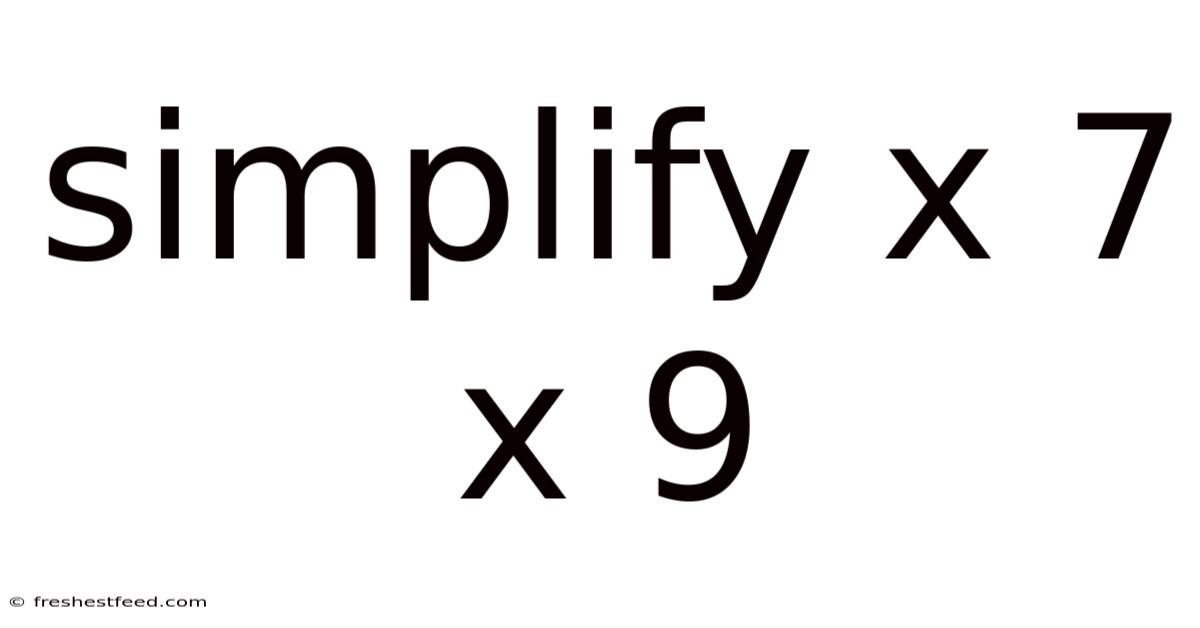
Simplifying x * 7 * 9: A Deep Dive into Mathematical Simplification
This article explores the seemingly simple mathematical expression "x * 7 * 9" and walks through the various methods and underlying principles of simplification. We'll cover not just the straightforward calculation but also the broader context of algebraic manipulation, order of operations, and the importance of understanding the fundamental building blocks of mathematics. This understanding is crucial for progressing to more complex mathematical concepts and problem-solving scenarios. Whether you're a student refreshing your foundational knowledge or someone interested in a deeper understanding of mathematical principles, this article provides a comprehensive overview Small thing, real impact..
Introduction: Understanding the Basics
The expression "x * 7 * 9" represents a simple algebraic expression. The asterisk (*) denotes multiplication. The variable 'x' represents an unknown quantity or a placeholder for a number. Our task is to simplify this expression, meaning to present it in its most concise and efficient form. Consider this: while the immediate solution might seem obvious, understanding the why behind the simplification process is equally important. This involves exploring the commutative and associative properties of multiplication.
This is the bit that actually matters in practice.
The Commutative Property of Multiplication
The commutative property states that the order of the numbers being multiplied does not affect the result. Here's the thing — this principle is fundamental to simplifying expressions. In practice, in simpler terms, a * b = b * a. So, we can rearrange the terms in our expression x * 7 * 9 without changing its value Still holds up..
Easier said than done, but still worth knowing.
- 7 * 9 * x
- 9 * 7 * x
- x * 9 * 7
- etc.
This seemingly minor rearrangement allows us to simplify the numerical part of the expression before dealing with the variable 'x'.
The Associative Property of Multiplication
The associative property states that the grouping of numbers in a multiplication does not affect the result. This means (a * b) * c = a * (b * c). Applying this to our expression, we can group the numbers 7 and 9 together:
x * (7 * 9)
This grouping allows us to perform the multiplication of 7 and 9 first, significantly simplifying the expression.
Step-by-Step Simplification
Now, let's go through the step-by-step simplification process:
-
Identify the numerical components: The numerical components in the expression x * 7 * 9 are 7 and 9 Worth knowing..
-
Multiply the numerical components: 7 * 9 = 63
-
Substitute the result: Replace the product of 7 and 9 (63) back into the original expression: x * 63
-
Final Simplified Expression: The simplified expression is 63x. This represents the most concise and efficient way to express the original expression. It's crucial to understand that 63x implies multiplication; the multiplication symbol is often omitted when a number is directly adjacent to a variable.
Expanding the Concept: Different Scenarios and Applications
While the initial expression was straightforward, let's explore scenarios that expand upon the fundamental principles involved:
-
Scenario 1: Solving for x: If we are given that x * 7 * 9 = 189, we can use the simplified expression to solve for x. We know that 63x = 189. Dividing both sides by 63, we get x = 3.
-
Scenario 2: Incorporating addition and subtraction: Consider the expression 2x + x * 7 * 9. We would first simplify the multiplication part (x * 7 * 9 = 63x), then combine the like terms: 2x + 63x = 65x Which is the point..
-
Scenario 3: Using negative numbers: If the expression were -x * 7 * 9, the simplification remains the same except for the inclusion of the negative sign: -63x. The rules of multiplication with negative numbers still apply.
-
Scenario 4: Introducing exponents: If the expression included exponents, such as x² * 7 * 9, the simplification would still follow the same logic: 63x². The exponent applies only to the variable 'x' and is not affected by the multiplication of the constants That alone is useful..
The Importance of Order of Operations (PEMDAS/BODMAS)
The order of operations, often remembered by the acronyms PEMDAS (Parentheses, Exponents, Multiplication and Division, Addition and Subtraction) or BODMAS (Brackets, Orders, Division and Multiplication, Addition and Subtraction), is crucial for ensuring correct calculations. Now, in our original expression, multiplication is the only operation, so the order doesn't affect the outcome. Even so, understanding PEMDAS/BODMAS is critical when dealing with more complex expressions involving multiple operations Small thing, real impact..
Explanation in terms of Algebra and Number Theory
From an algebraic perspective, the simplification demonstrates the concept of combining like terms. But the expression 63x shows that 63 is a common factor of the original expression. Practically speaking, the numbers 7 and 9 are constants, and they are combined through multiplication. In practice, from a number theory perspective, the simplification reveals the factorisation of the expression. This concept becomes more significant when dealing with larger numbers and more complex polynomial expressions Still holds up..
Frequently Asked Questions (FAQ)
-
Q: What if the expression was x * 7 + 9? A: In this case, the order of operations matters. You would perform the multiplication first (7x) and then the addition: 7x + 9. This cannot be further simplified Not complicated — just consistent..
-
Q: Can I simplify x * 7 * 9 if I don't know the value of x? A: Yes, absolutely. The simplification process focuses on combining the constant terms, regardless of the value of x. The simplified expression, 63x, is still valid whether or not x is known Which is the point..
-
Q: What if x is a negative number? A: The simplification process remains the same. The resulting expression will simply be -63x. The negative sign will apply to the entire expression after simplification.
-
Q: Are there other ways to simplify this expression? A: While the method described is the most direct and efficient, other approaches involve expanding the expression using the distributive property or factoring, but they would lead to the same simplified result of 63x.
Conclusion: The Power of Simplification
Simplifying mathematical expressions is a fundamental skill crucial for success in various fields, from basic arithmetic to advanced calculus. The seemingly simple process of simplifying x * 7 * 9 illustrates core mathematical principles like the commutative and associative properties and underscores the importance of understanding the order of operations. That's why the ability to efficiently simplify expressions not only saves time but also enhances problem-solving capabilities and deepens our understanding of mathematical relationships. In practice, mastering this fundamental skill lays a strong foundation for tackling more advanced mathematical concepts and challenges. The simplified expression, 63x, represents a concise and efficient representation of the original expression, highlighting the power of mathematical simplification in making complex problems manageable and accessible. Remember that the key to effective simplification is a solid understanding of fundamental mathematical concepts and the ability to apply these principles logically and systematically Simple, but easy to overlook..
