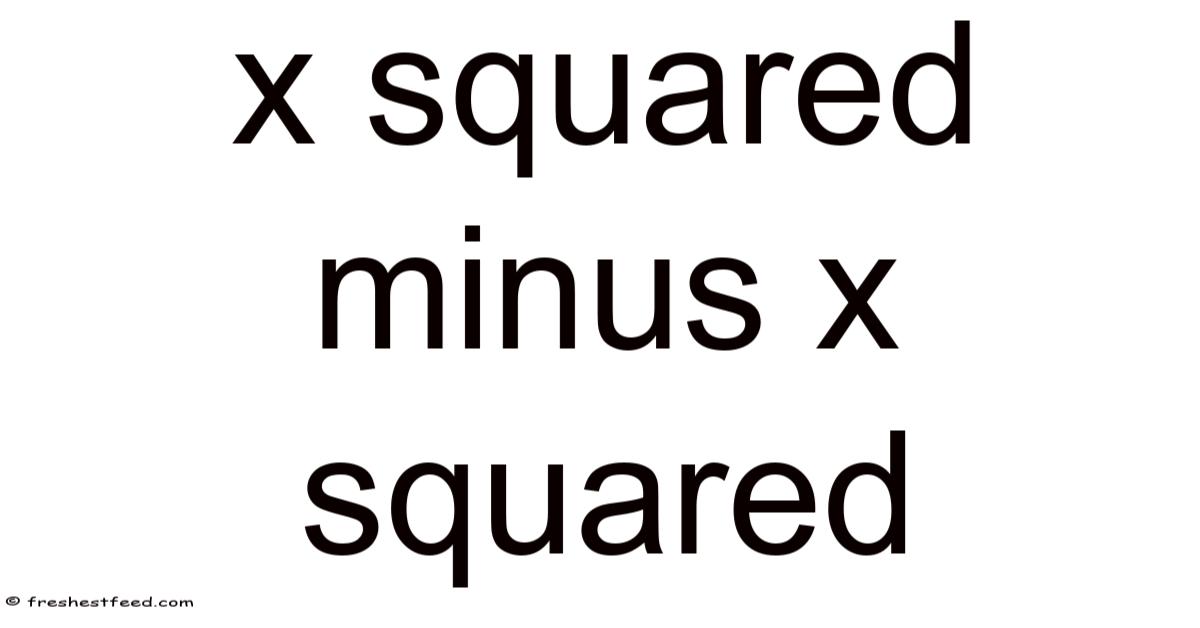
X Squared Minus X Squared: A Deep Dive into the Simplicity and Significance of Zero
The seemingly simple expression "x squared minus x squared" (x² - x²) might appear trivial at first glance. Even so, a closer examination reveals profound implications within the broader context of algebra, mathematics, and even our understanding of nothingness. This article will get into the intricacies of this expression, exploring its simplification, its significance in different mathematical contexts, and addressing common misconceptions. Understanding this seemingly basic concept unlocks a deeper appreciation for the fundamental principles of mathematics.
Introduction: Unpacking the Mystery
The expression x² - x² represents the subtraction of a quantity from itself. That's why this concept, while simple in its presentation, underlies many more complex mathematical principles. Still, it's crucial to understand that 'x' in this context represents a variable, meaning it can hold any numerical value. The core question we'll explore is: what is the result of this subtraction regardless of the value of x? The answer, as we will demonstrate, always leads to a consistent and fundamental outcome: zero Less friction, more output..
Step-by-Step Simplification: A Visual Approach
Let's break down the simplification process step-by-step, using both algebraic manipulation and visual representations.
-
Identical Terms: The expression x² - x² features two identical terms: x² and -x². These are like terms because they both contain the variable 'x' raised to the same power (2).
-
Combining Like Terms: The fundamental rule of algebra dictates that like terms can be combined through addition or subtraction. In our case, we are subtracting x² from x².
-
Simplification: x² - x² = 0
This simplification holds true regardless of the value assigned to 'x'. Whether x is 5, -2, 0, or any other number, the subtraction of a quantity from itself always results in zero The details matter here..
Visual Analogy: Imagine you have x² apples. Then you take away x² apples. How many apples do you have left? Zero. This visual representation reinforces the simplicity and intuitive nature of the algebraic simplification.
Exploring the Significance of Zero
The outcome of this seemingly simple equation—zero—is far from insignificant. Zero matters a lot in mathematics and across various scientific fields It's one of those things that adds up..
-
The Additive Identity: Zero is the additive identity, meaning that adding zero to any number does not change the number's value. This property is crucial in algebraic manipulations and solving equations. Here's one way to look at it: x + 0 = x, for any value of x.
-
The Multiplicative Zero Property: Any number multiplied by zero equals zero. This property is fundamental to many mathematical operations, including solving polynomial equations and matrix algebra. To give you an idea, x * 0 = 0, regardless of the value of x Worth keeping that in mind. Took long enough..
-
The Concept of Nothingness: Zero is a powerful concept representing the absence of quantity. It allows us to bridge the gap between positive and negative numbers, providing a foundational element for the number line and the representation of quantities Worth keeping that in mind..
-
A Foundation for Advanced Mathematics: The simplicity of x² - x² = 0 belies its importance. This fundamental understanding forms the bedrock for more advanced concepts such as calculus, where the concept of limits and infinitesimals relies heavily on the understanding of zero and its implications.
Addressing Common Misconceptions and Potential Pitfalls
While the simplification of x² - x² is straightforward, certain misconceptions can arise, particularly when dealing with more complex algebraic expressions.
-
Confusing x² with 2x: don't forget to remember that x² represents x multiplied by itself (x * x), not 2 times x (2x). These are distinct terms and cannot be directly combined.
-
Incorrect Application of Distributive Property: While the distributive property is essential in algebra, it should be applied correctly. Here's a good example: you cannot distribute a minus sign across a term that already contains a subtraction. The expression x² - x² is not the same as -(x² + x²) Turns out it matters..
-
Misinterpreting the Role of Variables: Remember that 'x' is a variable, capable of holding any numerical value. The result of x² - x² is always zero, irrespective of the specific numerical value substituted for 'x' Simple, but easy to overlook..
Beyond the Basics: Extending the Concept
The principle of subtracting identical terms extends beyond simple quadratic expressions. Consider the following examples:
-
3x³ - 3x³ = 0 The same principle applies to higher-order polynomial terms. Subtracting identical terms always results in zero And it works..
-
(x + y)² - (x + y)² = 0 Even more complex expressions, where 'x' and 'y' represent variables, follow the same rule. Subtracting an expression from itself always results in zero Simple as that..
-
Functions and Zero: In the realm of functions, if we have a function f(x) = x², then f(x) - f(x) = 0 for any value of x within the domain of the function.
These examples illustrate that the concept of subtracting identical terms, resulting in zero, is a fundamental principle that applies broadly across different mathematical contexts.
Frequently Asked Questions (FAQ)
-
Q: Is x² - x² always equal to zero, even if x is a complex number?
- A: Yes, even if x is a complex number (a number of the form a + bi, where 'a' and 'b' are real numbers and 'i' is the imaginary unit), the principle still holds true. Subtracting a quantity from itself always results in zero.
-
Q: Can this concept be applied in other areas of mathematics besides algebra?
- A: Absolutely. This concept of subtracting identical quantities to reach zero is fundamental across various mathematical branches including calculus, linear algebra, and number theory. It underlies concepts like limits, derivatives, and vector spaces.
-
Q: What if the expression was x² - y²? Would it still equal zero?
- A: No, x² - y² would not equal zero unless x = y. In this case, we are subtracting two potentially different quantities, and the result would depend on the values of 'x' and 'y'. This is a different scenario from subtracting identical terms.
Conclusion: Embracing the Power of Simplicity
While seemingly trivial, the expression x² - x² = 0 carries immense significance within the vast landscape of mathematics. The consistent result of zero highlights the fundamental consistency and predictability within the mathematical framework, reinforcing the reliability of mathematical principles. From basic arithmetic to advanced calculus, the underlying principle of subtracting identical quantities to arrive at zero remains a cornerstone of mathematical reasoning and calculation. Its simplicity hides a profound truth about the fundamental nature of zero and its importance as a building block for more complex mathematical structures. Understanding this simple principle builds a stronger foundation for tackling more layered algebraic manipulations and unlocks a deeper appreciation for the elegance and power of mathematics. This exploration has hopefully not only clarified the meaning of x² - x² but has also highlighted the importance of embracing seemingly simple mathematical concepts as they form the cornerstone for greater understanding.
